The Icesave legal dispute is on ESA's table at the moment. The presentation of the case is in Luxembourg today. What many people don't realise is that if Iceland loses the case, the sovereign ratings of EU countries will be likely to be seriously harmed. And here's why (the very short version).
Icesave was a branch of Landsbanki in Holland and UK. When Landsbanki went bankrupt the depository fund of Iceland had to pay out the depository insurance. However, the amount of money in the Icelandic Deposit Insurance Fund was inadequate to cover the minimum EU cover: 20,887 Euros (or GBP equivalent).
The governments of the three countries got into a lengthy negotiation and the outcomes of that negotiation were the Icesave contracts. They were nicknamed "Iceslave contracts" back home. We voted on them twice and in both cases the referendum was a clear "no".
Plenty of foreigners thought this was the Icelandic people saying "no" to paying bankers' debts. That's not true. The referendums were fortunate stop-valves on our own government that wanted to make a very expensive deal with the Dutch and the British instead of going straight to court and ask: "are we, the State of Iceland, legally committed to pay out the minimum deposit insurance in case of inadequate funds in the Deposit Insurance Fund?"
In other words: is there a sovereign insurance on Deposit Insurance Funds in Europe? The EU says it's so, we don't!
So if Iceland loses the Icesave case it means that there is a formal sovereign backup on the deposit insurance funds in all the EU countries. That means that the British, Spanish, Irish, Italian, Portuguese and German governments all insure the deposits in their banks (up to 20,667 euros) no matter where in the EU they are! Depositors in Greece can park their euros in Barclays and the government of United Kingdom solemnly swears that if Barclays goes bankrupt, the UK taxpayer will pay the euros back to the Greeks. The Spanish taxpayer will reimburse the Brit who has his or her money in Santander and so on. The important difference between a subsidiary and a bank branch becomes effectively none when it comes to deposit insurance for the depositor (Kaupthing Edge was a subsidiary of Kaupthing while Icesave was a branch).
Anybody wants to make a wild guess what happens to the sovereign ratings of those countries if they are legally required to back up the deposit insurance funds? I don't think that liability is e.g. on the books of the Spanish government. Nor is it on the Dutch books.
Showing posts with label sovereigns. Show all posts
Showing posts with label sovereigns. Show all posts
Tuesday, 18 September 2012

Wednesday, 11 July 2012
Austerity and Interest Rates
In light of Spain's toughening of austerity measures, it's worth doing a bit of data cracking and comparisons on budget deficits and government bond interest rates.
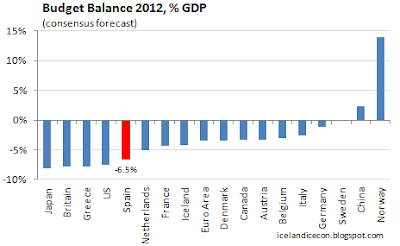
First, this is how the projected budget deficit of Spain compares to other economies. Data comes from the newest issue of The Economist (Iceland's budget deficit figure is full year 2011). According to the WSJ, the aim is to get Spain's deficit down to 6.3% this year (instead of previous target of 5.3%) and 4.5% in 2013. By 2014, the deficit is to dip back under the 3% Maastricht line: 2.8%.
The aim of the game is to get the interest rates down so Spain (and the EZ as a whole) doesn't collapse. That makes sense, looking at this scatter plot below: an obvious negative correlation between budget balances and interest rates, meaning that if a country is suffering increased budget imbalances, the interest rates on its government bonds tend to go up.

But oops, that's not what it seems to be when we look at countries with their own currencies and not the euro. They seem to be able to spend all they want without fearing higher nominal rate of interest. Yes, I know the 1970s and 1980s stories. But in times of dull economic activities, as is the case nowadays, it seems quite all right for the government to spend all it wants as long as the economy is using its own currency.

Both scatter plots above have outliers that could possibly be bending the fundamental relationship. So if we skip some notable outliers (Iceland, Norway [who has positive budget balance amounting to 13% of GDP anyway?], Greece, Spain, Italy) we get the following scatter plot.

Two things to notice about this final plot:
- it seems the relationship between budget balance and the rate of interest on government bonds is positive, completely contrary to neoclassical theory: if the state increases its budget balance, it will be charged higher rate of interest.
- all the EZ economies, except Germany, are above the trendline. Denmark is of course pegged to the euro, we can argue whether we should put it with the EZ economies or not.
So those fiscal-neoclassicals (commonly but incorrectly known as "Keynesians") out there might be right but maybe only half-right: we can end this depression now if we use the public finances to increase monetary demand in the economy and give people a chance to repay their debts, but only if the economies in question have their own currencies; the EZ economies would find this spend-and-survive strategy "a bit more" difficult.
Good luck Spain on cutting down the deficit, get unemployment down to humane levels and end this depression. You're going to need it!
First, this is how the projected budget deficit of Spain compares to other economies. Data comes from the newest issue of The Economist (Iceland's budget deficit figure is full year 2011). According to the WSJ, the aim is to get Spain's deficit down to 6.3% this year (instead of previous target of 5.3%) and 4.5% in 2013. By 2014, the deficit is to dip back under the 3% Maastricht line: 2.8%.
Projected budget deficits for 2012. Data from The Economist

The aim of the game is to get the interest rates down so Spain (and the EZ as a whole) doesn't collapse. That makes sense, looking at this scatter plot below: an obvious negative correlation between budget balances and interest rates, meaning that if a country is suffering increased budget imbalances, the interest rates on its government bonds tend to go up.
"Don't spend your money or we'll charge you extra high interest rates"

But oops, that's not what it seems to be when we look at countries with their own currencies and not the euro. They seem to be able to spend all they want without fearing higher nominal rate of interest. Yes, I know the 1970s and 1980s stories. But in times of dull economic activities, as is the case nowadays, it seems quite all right for the government to spend all it wants as long as the economy is using its own currency.
"You can spend your money all you want, as long as you can create it yourself"

Both scatter plots above have outliers that could possibly be bending the fundamental relationship. So if we skip some notable outliers (Iceland, Norway [who has positive budget balance amounting to 13% of GDP anyway?], Greece, Spain, Italy) we get the following scatter plot.
"Please borrow and spend, we'll charge you lower rate of interest if you do so!"

Two things to notice about this final plot:
- it seems the relationship between budget balance and the rate of interest on government bonds is positive, completely contrary to neoclassical theory: if the state increases its budget balance, it will be charged higher rate of interest.
- all the EZ economies, except Germany, are above the trendline. Denmark is of course pegged to the euro, we can argue whether we should put it with the EZ economies or not.
So those fiscal-neoclassicals (commonly but incorrectly known as "Keynesians") out there might be right but maybe only half-right: we can end this depression now if we use the public finances to increase monetary demand in the economy and give people a chance to repay their debts, but only if the economies in question have their own currencies; the EZ economies would find this spend-and-survive strategy "a bit more" difficult.
Good luck Spain on cutting down the deficit, get unemployment down to humane levels and end this depression. You're going to need it!
Thursday, 21 June 2012
High rates or not?
I translated (and expanded) the post about Iceland prepaying the crisis-money ahead of schedule into Icelandic and posted it on my blog back home. In the wake of it, I got some comments and nudges such as:
- the coupon on the bond isn't 6.0% but "3.something" and then the market adjusts the price to whatever it thinks is appropriate
- 6.0% isn't too bad compared to other countries (I reckon with similar credit rating)
- USD isn't the currency of Iceland, therefore it's only normal that the risk on this USD bond is high
OK, so I went to the Bloomberg terminal here in Exeter (one of the few British universities that has an access to a Blooomberg terminal) and spent an hour looking up international bonds issued by other sovereign countries. This table summarises what I found:

I tried to find sovereigns with similar credit rating and followed Moody's on that - I noted S&P's and Fitch's ratings as well. If I didn't find a bond maturing in 2022 I went for the one closest to that year. All bonds are in USD.
So what is this comparison telling us:
- of the Baa3 rated countries, only Croatia is getting a worse deal than Iceland. The yield on the Hungarian bond is higher than that of Iceland but it receives speculation grade.
- there are three Ba1 (speculation grade) countries that seem to get a better deal than Iceland. Notice especially Uruguay but that bond is sinkable so they should be getting a better deal.
- the yield on the Philippine bond is half the yield on the Icelandic bond, despite the fact that the Philippine bond is two credit notches worse
- many countries with float, managed or not, are getting a considerably better deal than Iceland. So can we really conclude that not having the USD currency as a legal tender is such an important factor?
- apparently, being pegged to the USD isn't so great: Panama is charged higher rates than Peru, Colombia and Indonesia which all have floating currencies. Same goes for the comparison between El Salvador (USD peg) and Philippines (float).
- Go Colombia! Callable (in 2020 if I remember correctly, was foolish enough not to note it down) but all the same getting 2.8%. I wonder why they seem such a good Baa3 borrower, they must be getting the dollar-flow from somewhere to justify that...
I stand by what I said: this bond issuance of Iceland is a badly done job and absolutely not "successful" like the Ministry of Finance held. Iceland shouldn't be paying 6.0% rates if we compare it to other sovereigns. 3-4% is certainly possible, especially if we go for a sinkable bond a la Uruguay.
And by the way, the coupon on the Icelandic bond is 5.875%, which is of course why there was quadruple over subscription. I reckon the underwriters took some fee so the rates in the end were equivalent to 6.0% like the Ministry of Finance announced.
- the coupon on the bond isn't 6.0% but "3.something" and then the market adjusts the price to whatever it thinks is appropriate
- 6.0% isn't too bad compared to other countries (I reckon with similar credit rating)
- USD isn't the currency of Iceland, therefore it's only normal that the risk on this USD bond is high
OK, so I went to the Bloomberg terminal here in Exeter (one of the few British universities that has an access to a Blooomberg terminal) and spent an hour looking up international bonds issued by other sovereign countries. This table summarises what I found:
Examples of USD bonds issued by sovereign states and maturing roughly in the same year as the Icelandic bond issued in May. Click to enlarge.

I tried to find sovereigns with similar credit rating and followed Moody's on that - I noted S&P's and Fitch's ratings as well. If I didn't find a bond maturing in 2022 I went for the one closest to that year. All bonds are in USD.
So what is this comparison telling us:
- of the Baa3 rated countries, only Croatia is getting a worse deal than Iceland. The yield on the Hungarian bond is higher than that of Iceland but it receives speculation grade.
- there are three Ba1 (speculation grade) countries that seem to get a better deal than Iceland. Notice especially Uruguay but that bond is sinkable so they should be getting a better deal.
- the yield on the Philippine bond is half the yield on the Icelandic bond, despite the fact that the Philippine bond is two credit notches worse
- many countries with float, managed or not, are getting a considerably better deal than Iceland. So can we really conclude that not having the USD currency as a legal tender is such an important factor?
- apparently, being pegged to the USD isn't so great: Panama is charged higher rates than Peru, Colombia and Indonesia which all have floating currencies. Same goes for the comparison between El Salvador (USD peg) and Philippines (float).
- Go Colombia! Callable (in 2020 if I remember correctly, was foolish enough not to note it down) but all the same getting 2.8%. I wonder why they seem such a good Baa3 borrower, they must be getting the dollar-flow from somewhere to justify that...
I stand by what I said: this bond issuance of Iceland is a badly done job and absolutely not "successful" like the Ministry of Finance held. Iceland shouldn't be paying 6.0% rates if we compare it to other sovereigns. 3-4% is certainly possible, especially if we go for a sinkable bond a la Uruguay.
And by the way, the coupon on the Icelandic bond is 5.875%, which is of course why there was quadruple over subscription. I reckon the underwriters took some fee so the rates in the end were equivalent to 6.0% like the Ministry of Finance announced.
Subscribe to:
Posts (Atom)