Showing posts with label bubbles. Show all posts

Monday, 2 December 2013

The Icelandic Debt Relief

The hottest story coming from Iceland now is the one about the government-initiated debt relief to households. Here is my take on it, focused only on handful of all the questions and issues related to the act itself and, perhaps more importantly, the potential economic development in the future. Especially on that front we have a sea of unanswered questions. Is this going to be inflationary? What about economic growth, unemployment, investment levels, etc.? The balance of payments? Will this help or hinder the abolishment of capital controls?

First some useful links (in English) that I found. They are unfortunately not many... classic Icelandic lack of communication problem... (if you've got some others, please leave a comment):
FAQ on the website of the Prime Minister's Office
The news itself on the same website
Bloomberg - Creditors in Iceland Banks Face Pressure to Speed Up Settlement (by an Icelandic journalist).

The basics
Framsóknarflokkurinn (e. The Progressive Party, PP - they are conservative) promised to carry out a debt jubilee if it would be elected into power in the last general elections. They were. The other half of the coalition is Sjálfstæðisflokkurinn (e. The Independence Party, IP - conservative).

Those two parties did not agree on how the debt should be cancelled. The PP wanted to straightforward cancel it. They were talking about up to ISK 300 billion just before the elections, the actual amount turned out to be half that. The IP thought that cancellation would be impossible since it would either be simply illegal on the grounds of property rights and / or too expensive for the State in case the State was going to foot the bill for cancelling the debt of households. Their take was to use the tax system and create incentives for people to use the 3rd pillar of the pension system - the private pension holdings - to get tax-free additional income to be spent on paying down debt and only to pay down debt.

The outcome is a mix of both. ISK 80bn. (roughly GBP 400 million) of household debt will be outright cancelled. Additional ISK 70bn. are to become available via allowing people to use their 3rd pillar pension savings in the next three years, to pay down their household debts.

So what's the crack? 
Icelandic households will get ISK 150bn. (GBP 750 million) of their household "cancelled", spread over a four year period. I say "cancelled" because they are in fact paying down ISK 70bn. of it themselves, the only thing is that they get to use tax-free pension savings to pay down that part. And that makes perfect sense by the way: why save in an illiquid form at 2-3% real interest when you have debt to pay that charges a 4-5% rate of interest.

The rest, ISK 80bn., will be outright cancelled in four annual instalments although the borrower will feel the positive impact on his monthly payment burden immediately. Each household that has an indexed mortgage, partially or wholly, (check this link to see how indexation of Icelandic mortgages works), specifically declared to buy a property for own use (buy-to-let mortgages are excluded!) will get a maximum of ISK 4 million of the debt written off. Non-indexed loans get no write-off but the tax-free pension savings can be used to pay additionally onto the principal in the future. The tax-free pension savings can also be saved and later used to buy a flat. This is why they say that even current tenants will benefit from the measures. If the household got its debt cancelled via e.g. the 110% measure this will be accounted for and the current write-off will consequently decrease.

The following is a copy-paste from the slides about the measures. The way you should read this is the following. The x-axis is the time when an ISK 15 million mortgage was taken out. The graph (grey area) shows the nominal amount of that debt today (Remember, the principal of indexed Icelandic loans INCREASES in value parallel with the CPI. That's the reason why an ISK 15 million mortgage taken out in e.g. September 2001 would amount to about ISK 25 million today according to the graph). The blue area is the debt after the debt has been cancelled and the light brown (beige??) area is the amount of the mortgage once a 3 year private pension pay-down has been accounted for. So the decrease is read vertically and depends on when the loan was taken out. Click to enlarge.

The principal of an ISK 15 million mortgage and how it is affected by the jubilee, depending on when it is originally taken out

Now, most of the questions, and some answers, about how and why and what for and all that can be found in the FAQs from the Prime Minister's Office. So head over there to read further on how the whole thing is carried out. I would rather spend time on some other issues, such as:

Is this significant?
That depends on how you look at it I suppose. This jubilee is not gigantic in comparison to the debt that has already been cancelled since 2008. On that note, I honestly think this nice info-graphic, which is circulating on Facebook from a group that is politically, well, not keen on the current government, says it all. To give the current government some rightful credit (pun intended): their measures are more significant, by a mile, than the previous government's measures (because they had nothing to do with the pink part of the left column).

Comparison of how much household debt has been cancelled in Iceland since The Crash.
The headline ("heimsmetið") is a reference to the prime minister who said that his government's jubilee was a "world record". The left column is debt that was cancelled during the coalition rule of last government. The colours represent the following: purple (12bn) - special interest benefits, pink (155bn) - correction due to illegal FX-indexed loans (this came through the justice system and had nothing to do with the former government), orange (8bn) - special debt measures, yellow (48bn) - the 110% way (any debt above 110% of your property value was written off), grey (15bn) - increased interest benefits, blue (70bn., the IP's campaign colour) - Tax-free pension savings, green (80bn., the PP's campaign colour) - debt jubilee.

So in comparison to the previous write-off of debt in Iceland, governmentally initiated or not, the current jubilee is not so huge.

However, it is significant from the point of view of proving that this is politically possible! And that's something for other nations to learn from! Jubilees do not need to be a thing of biblical times! (But of course, that does not mean that they are always a smart move!)

But how are they paying for all this?
Right, that's a bit hazy to be honest. The short answer on the list of FAQs on the website of the prime minister's office is a classic nonsense answer that doesn't add any value:

"How is the debt relief financed? The Treasury will collect increased revenues in the next four years to cover the cost of additional state expenditure resulting from these actions. The actions will therefore neither be financed by additional Treasury borrowing nor with the granting of state guarantees."

Right, so the no-bullshit answer is that you're going to increase taxes - or "collect increased revenues..." Then just say it!

Where are they going to "collect increased revenues"? From the old banks. Through taxation. Specifically, they are going to tax the estates of the old banks, i.e. the bankrupt banks since 2008. Their liquidation process is going veeeery slowly, to a large extent because of the capital controls and the tug of war between them and the liquidation process of the old banks: the capital controls hold it back but the estates have to be liquidated in the end before we can abolish the capital controls. Well, that's a nice one: like being a driver with two back seat drivers, one demanding you drive faster and the other demanding that you slow down. Which one are you going to make unhappy?

The government is going to make the old banks unhappy. Besides outright taxation on the them to pay for a debt jubilee for households, they are considering changing laws that would force them to speed up the liquidation process.

I've got two immediate concerns about this.

First, those are two birds in the bush but not one in the hand. Are we definitely sure that they can tax the old banks? This sentence alone from the slides says it all (slide 56): "The committee [behind the debt jubilee] assumes that the measures will be fully funded over a period of four years" (i. "hópurinn gefur sér þá forsendu að aðgerðin verði fullfjármögnuð á fjórum árum.").

Great going guys, I do this all the time as well! I always just book my vacation to French Polynesia and just assume that I can finance it! ISK 80 billion!? Pennies mate, I'll pick them up off the floor one day!

And even if they can tax the old banks specifically (there are some concerns about whether it would be constitutionally possible or not), won't the old banks, which are the main owners of Arion and Islandsbanki, not just pass at least part of the cost onto their customers? Competition in the banking industry in Iceland isn't great you know.

Second: OK, if we can tax the old banks to get cash for a debt jubilee, couldn't we have used the money for something else? Like not practically shutting down the Icelandic public radio? Or pay decent wages to doctors, nurses etc.? Not putting myself up against the debt relief as a principle, just pointing out that we didn't have to spend all the cash on it.

Or maybe we can tax them even more and spend that tax income on something nice!?

But how do they actually do this?
1. The mortgages are split up into "primary" and "secondary" parts.

2. The primary part (about 87% of the mortgage to be written down) is the new debt of the borrower. This loan has the same loan stipulates as the original loan, i.e. same rate of interest, indexed to CPI, etc.

3. The secondary part is interest and indexation free. There are no payments of that debt. Both of the loans are on the balance sheet of the borrower and the financial institution that owns the original loan. The total payment burden therefore contracts immediately and not over four years.

5. Annually, the State buys back 25% of the original amount of the secondary loan from the financial institution (hence the fact that this will take four years to finish). This is roughly ISK 20 billion annually, hence the total ISK 80 billion write off. The debt is then written off. The income to fund this is meant to come from the estates of the old banks themselves.

What about the economy?
The government estimates that with all this they will manage to get household debt below 100% of GDP. Such a debt level is still quite high and may still be a barrier to economic growth and financial stability, especially since interest levels in Iceland are stupefyingly high in comparison to other economies.

Nevertheless, this should help. Analytica, a consulting company back home, reckons the effects of the jubilee will be the following for 2014 only:
- economic growth: +0.1%
- inflation: +0.1%
- current account balance: -0.2%
- consumption: +0.4%
- investment in new properties: +2.0%

My take in short
Now, there are some good things about this measure.

First of all, they did it! Jubilee is here, well done guys! You proved this is politically possible and economically this does not seem to be an absolute nonsense. So this opens up the possibility of doing this in other countries. Whether that would make economic sense has to be discussed for each economy. Some very indebted households will feel quite relieved and this will have positive impact on the economy although the impact may be short lived (see more why below). The tax-free pension part of it all also makes perfect sense and simply boils down to the fact that it is not smart to save on 2-3% rate of interest when you owe debt bearing 4-5% rate of interest.

But I do have to admit that I have concerns, besides the obvious ones like the taxation issue (which may well enough not be so important). There are a few reasons why.

First, the primary loan, or the new loan, that the borrower has to pay off will still be indexed, just like the original loan that now is being partially written off. We will therefore still have all the negative effects of indexing mortgages in Iceland, including more volatile inflation, higher inflation, higher rate of interest, lesser effectiveness of the monetary policy and the risk of having to have another debt jubilee in 10 years time or so.

Second, and closely related to my first concern: although there is no direct increment in money supply because of the measures we can, I believe safely, assume that not only will we have some potential demand-pulled inflation immediately in the wake of all the jubilee but increased credit demand as well (especially if we have an increase in moral hazard due to all this: will people take on more debt because they anticipate another debt jubilee in the future?). As the increased credit demand will be met with new loans that increase the money supply we will end up with further inflation pressures. And because the principal of indexed debts will grow with more inflation we will get some, or even all, of the "jubileed" debt back. The Central Bank will also respond with an interest hike to try to hold credit demand back. That will hit the borrowers with non-indexed loans as their interest rates are potentially readjusted upwards. (More effective and sensible way of limiting credit growth and inflation would be to impose direct credit controls and connect them to the banks' own net holdings of liquidity in foreign currencies. But I doubt the Central Bank will go down that road: you can't teach old dogs how to sit).

Why, oh, why did they not make it compulsory to change the new primary loan into a normal non-indexed loan? A golden opportunity to get rid of this pest that indexed mortgages are has been wasted!

Third, although the net assets of the old bankrupt banks will contract (assuming everything goes according to plan) we will still have "considerable" pressure on the balance of payments because of increased consumption and demand. Now, of course, part of the reason for those measures is to revive household consumption. But if we will get into even further riskier waters with the balance of payments than we are in, doesn't that just signal that the exchange rate is too strong? And imagine what will happen when and if the exchange rate goes down: inflation goes up, principal of debt grows back, we're back on square one.

So again: why, oh, why did they not abolish indexation parallel to those measures?!

Fourth, and this is perhaps my most serious concern. We haven't fixed the institutional drawbacks of the Icelandic economy. Besides still having the indexation on mortgages, we still have a high self-imposed rate of interest stemming from the pension system. (It is regulatory required to get a real rate of return of 3.5% and it controls assets equal to about 120-130% of GDP. What do you think will happen to the long term rate of interest with such gigantic buyer of financial liabilities who demands a high minimum rate of interest. Has anybody heard of monopsony?). We also still have high short-term rates, to a large extent because of the indexation.

So I fear that the net effects of this debt jubilee will not be significant in the long run. At least from an economic point of view. Politically, this may fuel some fires, even in other countries where over-indebted populations may be nudged to demand jubilee there as well. In some cases those potential jubilees might make sense. The taboo of debt relief has just been delivered a blow. Maybe we can actually discuss it in a more sensible manner from now on and not with cries coming from both sides.

That is all well and square, but when it comes to the Icelandic economy, I fear we will only have short spurts of economic bounce back. It is not enough to cut the leaves of the weed, we need to dig out the roots as well.

Tuesday, 15 January 2013

"Stock prices have reached what looks like a permanently high plateau"

If only that would be true...

Blatant signs are for a classic bubble forming on the Icelandic stock exchange - again! Since the beginning of the year, stock prices have practically reached a lift-off speed and defied the market's law of gravity.

The stock index in the Icelandic stock exchange. Taken from Keldan.is. Click to enlarge.


Why this happens one can only speculate about but a not so unlikely spark is the existence of the capital controls which prevent the Johns and Jonases of Iceland to take their money out of the economy. Investors are therefore locked in, searching for investment opportunities in despair.

Many have parked their money in the banking system with its government backup. Others have funded the increased stock of bonds - especially government bonds as touched upon here - but the market value of registered bonds has risen up to 2,160 billion ISK from 1,390 billion ISK in October 2008. The yield of government bonds has dropped significantly as well, dipping below the yield which would neutralise the actuarial calculations of the Icelandic pension funds but they control around 55% of the total worth of registered bonds in the Icelandic stock exchange. Something tells me that the Icelandic pension funds may not be so eager to hold the too-low-yield-for-them bonds anymore once they will be allowed to invest again abroad.

Other trapped investors have decided to jump on the equities bandwagon, especially after the media began to show the price developments on the stock market some interest (such as here, here, here and here).  Like you can count on women flocking to the shops of Paris during the "soldes" period, investors followed the crowd and poured money into the stock market: the turnover of stocks in the first days of the year 2013 was fivefold the average turnover in 2012. Can anybody smell the "permanency" of this newly found stock plateau?

Nothing lasts forever, all stock runs run out in the long run. But who cares about the long run anyway! In the long run we're all dead and today's politicians (and Lords of Finance) will have managed to throw the burden of steering the economy away from recreating the financial turmoil of 2008 onto somebody else's new and unexpected shoulders. And of course the poor soul who is unlucky enough to be in command at the time of the burst of the bubble will take all the blame.

So jump on the bandwagon, enjoy the Beauty Contest and make money beyond your wildest dreams. Just don't come running back to me when you lose them all.

Monday, 13 August 2012

The Shortage of FX in Iceland

Iceland has strict capital controls at the moment. A permission is needed from the Central Bank to move money out of the country. And if you're in the exporting business, you have to sell your foreign currency income to the Central Bank.

All this is done to preserve the foreign exchange reserves of Iceland, reserves that are almost completely borrowed from the IMF, Scandinavian countries and others. However, there is a great shortage of FX in the country as is rather blatant by the existence of the capital controls.

Andri Gudmundsson, CEO of H.F. Verdbref ("H.F. Securities"), said that the problem was that Icelanders spent too much on imported goods. This is quite fantastically right! And the lack of FX will end up with the krona falling in value. But how are we managing to spend so much on imported goods? Where is the spending power, in ISK, coming from in the first place?

The source of that spending power has traditionally been the banking system. When the banks extend loans they create the borrowed money out of thin air. The extra money in the economy is then spent on goods, including imported goods of all kinds (investment and consumer goods). When we've borrowed a lot and spent the lot on imported goods we realise we're in FX problems. The krona then falls in value when the market sobers up. The fall in the value of the krona defers people from spending their money on imports and helps exports to gain foothold.

The story is always the same in Iceland: the krona has never fallen in value unless there is expansion of bank loans in the years before. Using the data from Statistics Iceland, that's rather blatant.

Four distinctive periods are very obvious in the economic history of Iceland when it comes to expansion of bank loans and the subsequent fall in the value of the krona. 


After the bank-loan expansion that fuelled and funded the bubble that collapsed in 2008 the external balance of the macroeconomy was in ruins; we had more than 20% current account deficit in 2006 after massive imports of all kinds of consumer and investment goods. Then the krona finally collapsed.

The krona-collapse in 2008 was not enough. It's somewhat like the exchange rate collapse in 1950; ten years and some bank-loan expansion later we had another and more severe devaluation. There is still too much of kronas in the economy in comparison to the FX reserves, which is of course why we have the capital controls in the first place. And despite all the devaluation of the krona, we are still running the current account deficit in the negative territory. One reason for that is the fact that the banks are lending out money again, now in the form of unindexed mortgages. And all that money is fresh off the banks' conveyor belt.

The plan and the aim is to abolish the capital controls in 2015. That plan will fail at the pace of the recent progress. We need to get serious.

Monday, 11 June 2012

The New GDP Figures

Statistics Iceland issued a new set of quarterly GDP figures for Iceland just before the weekend. The results: 4.2% real growth (seasonally adjusted) between 1Q11 and 1Q12. The Minister of Economic Affairs - or his assistant as the Minister of Economic Affairs is also the Minister of Agriculture and the Minister of Fisheries - immediately wrote an article in the most read newspaper, saying that "the [economic] improvement had been thoroughly confirmed."

Well, yes, there is growth! But not because the government is doing anything about it - it's always easy to have a comparatively better economic situation than during an outright economic collapse - and rather simply because Koo's balance sheet recession bounce-back is in play.

I wrote about in December: the Icelandic economy was in a "Lehman Brothers shock" where the actual bankruptcy effects and the sheer collapse of the financial system had been the main contributor for the collapse in GDP. But once the financial panic cleared out of the system the GDP growth came back, automatically, as the economy calmed down. In the meanwhile, balance sheet recession was inevitable since too much corporate and household debt made it impossible for the economy to grow at a rate that was even close to what it had been growing at before.

I might be fooling myself and under the spell of Galbraith ("faced with the choice between changing one's mind and proving that there is no need to do so, almost everyone gets busy on the proof") but I'm going to stick to that case: the Icelandic GDP growth is due to an automatic bounce-back from the financial collapse and panic and the "thoroughly confirmed" economic improvement is in reality an economy that is burdened with a balance sheet recession.


I've got some points to argue why:

1. GDP growth is considerably lower now than it was before, even measured in ISK. Notice how comparable the quarterly GDP growth figures are to Koo's "Lehman Shock" theory (see next set of figures).

Growth in GDP, measured in ISK, is still below what may be considered as historically normal. The sluggish growth is a sign of a balance sheet recession where debt and debt deflation are holding the economy back.


2. The above GDP growth figures are in the domestic currency. Icelandic GDP measured in Special Drawing Rights (SDRs) is merely the shadow of itself - a 65% shadow of itself to be exact since the value of Icelandic GDP has collapsed by 35% since its top in 2007. Admittedly, this is better than the horrendous 45% collapse straight after and during the collapse but again, that is an automatic bounce-back from the panic and not genuine "thoroughly confirmed" return of economic health.

Icelandic GDP measured in non-CPI deflated SDRs (billions of SDR per quarter). Compare the Iceland's GDP growth figures to Exhibit 16 from Koo's paper


3. Investment is still not coming back, causing historically very high unemployment. I know +7% unemployment may not sound much in the ears of a young unemployed Spanish person but for Iceland, that's pretty high. Those are, as far as I can figure out, numbers that are more or less comparable to U-3 unemployment (no U-6 unemployment figures are available).

Investment as a share of GDP, four-quarter moving average. Investment has hardly bleeped above 15% of GDP while it needs to be much closer to the 20% value to be considered "normal".


4. The debt deflation is quite simply so obvious in the the new Central Bank's data on financial stability that we need not discuss the matter any further. The Icelandic economy is in full-swing debt deflation! And contrary to what the Central Bank might think, raising the interest rates is not the right thing to do in such a situation!!

Debt of Icelandic households, % of GDP. Blue = indexed; purple = FX linked; orange = nonindexed loans, comparable to normal mortgages in Europe; green = overdraft; dark blue = leasing contracts


Number of individuals on list of deferred payments (red line: number of bankruptcies and unsuccessful attached properties)


Debt of non-financial corporates as % of GDP. Blue = CPI indexed; purple = nonindexed, normal loans; orange = FX linked (great idea, lets mostly indebt us in foreign currencies!!)


Debt of non-financial corporates, European comparison (% of GDP). Does anybody know the Icelandic word for "debt deflation"?


So I'm afraid I'm just as bearish as before: the Icelandic economy is in the fastest debt deflation process that I've ever seen. 

The main thing that makes this possible is the around 40% discount the Icelandic banks received as their "birth gift" when they were established in 2008: the loan portfolio was transferred from the old banks into the new ones at a 40% discount which was not forwarded to the borrowers who saw their debts, in many cases, grow in monetary terms due to indexation of mortgages. 

As long as the banks are milking out the discount they received in 2008, the economy will not collapse entirely again. But that's only for the short term. If the debts are not gotten rid off, the problem will persist. And the intrinsic systemic factors lead to ever growing value of debts, due to high interest rates and indexation on mortgages. The financial system has to be reformed bottom up - pension funds and indexation are on the top of the list and close thereafter is the monetary policy - simply because it will not stand the test of time in its current form. The Icelandic financial system is built to collapse, just as it was before 2008.

Thursday, 31 May 2012

Bloomberg bested: Update on the "Housing Bubble"

Bloomberg had an article recently where the currency controls were blamed for a formation of another possible housing bubble in Iceland. The take was that since the capital/currency controls locked funds inside the economy and investors were finally realising that they were going to be around for a long time, they best get their money into cement rather than let them rot in low-interest deposit accounts or bonds. The influx of money into the housing market then creates and supports unsustainable house prices - and inflation since housing is about 20% of the Consumer Price Index base in Iceland.

House prices went through the roof in mid 2000s only to come down crashing again. Now nominal prices are rising again, pulling inflation up with them.


I am not going to disagree on the possible formation of an unsustainable rise in the housing prices in Iceland supported with funds of high net-wealth investors, I already warned of that in February (Daily Mail and House Prices in Iceland). I am, however, going to emphasise the point that the influx of money into the housing market due to the capital controls is massively supported by creation of new mortgages (Bloomberg mentions this). Taking the expansion of new mortgages into account I'm not so sure the (acclaimed) flow of capital-controls-locked money into the housing market matters that much on its own, it is the leverage in the form of mortgages that brings the fuel.

First, what seems to support the view that capital-controls-locked money is mainly causing the rise in housing prices is the apparent divergence between new mortgages and prices, starting in mid year 2011 or so. Until then, house prices had always run parallel to the issuance of new mortgages. 

New mortgages and change in house prices. Notice the apparent divergence around mid year 2011 supporting the view that the recent rise is only caused by new funds locked in by the capital controls.


But cracking the data shows that the connection between new mortgages and the change in house prices is still around - correlation of 0.83. Both the change in the flow of new mortgages and the acceleration of the flow of new mortgages are still strongly connected to the change and acceleration of house prices. And notice that the mortgages lead the change in house prices, not the other way around!

Although the flow of new mortgages into the market has dislocated itself with the change in house prices (see previous graph) the change in the flow has certainly not!


Relative acceleration of house prices and relative acceleration of new mortgages (if new mortgages accelerate, the change in house prices should as well). Mortgages have been rather constantly accelerating since May 2010 and guess what, so have housing prices. Mortgages are still driving the housing market, with help from new funds or not.


In conclusion, the locked-in money is not suddenly infusing the rise in housing prices on its own. The connection between house prices and mortgages is still around and still going strong and I do not see any reason for changing my opinion since February: high net-wealth investors use mortgages to leverage up their position in the housing market. 

Good thing Bloomberg finally picked that up.

Tuesday, 22 May 2012

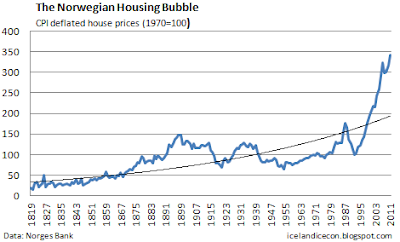
Behold the Norwegian Housing Bubble

Nuff' said!


And here is a comparison to Denmark and Sweden from  Statistics Norway.


In relation to this, the Norwegian Minister of Finance pointed out that households in Norway had never been so indebted. Now the only question is when the self-delusion will be realised by the public, which is probably going to be quite late as it is the common man himself who is doing the self-delusion.

Monday, 14 May 2012

Another Look at the Eurozone Crisis

Used the OECD stats to make those:

Investment as a share of GDP, quarterly data, seasonally adjusted


Government consumption as a share of GDP, quarterly data, seasonally adjusted


One can see the investment boom in Spain and Ireland very clearly on those pictures. That boom was fuelled with credit (created at home and coming from Germany amongst other countries) even though it doesn't show on the graph above.

And with the same graph in mind, one can understand why employment has collapsed: lower investment - contraction in wage income - lower wage income - private debt distress - liquidation - fall in asset prices - lesser investment still... and so on.

The only way to keep employment and the economy going is to call for public investment projects (included in the investment graph) and if they don't come, next in line is government consumption, such as pension funds, employment benefits, etc., to maintain cash flows to the public since people don't get investment-employment any more.

But that wasn't allowed: Ireland's and Greece's state coffers were squeezed "since it is the solution to the eurozone crisis" said the slaves of some defunct economist. Ireland and Greece were in fact squeezed so hard that now they are squeezed more than the main squeezer is squeezing his coffers: Germany. Spain is just around the corner (see government consumption graph above).

So when the State cannot meet the collapse in demand from the implosion of investment, public and private, the unemployment skyrockets.

Unemployment levels in the eurozone - Total Unemployment

Unemployment levels in the eurozone - Unemployment amongst people under 25 years


And when the unemployment goes up, as it did in the 1930s, we get to see social unrest and Molotovs flying:

A motorcycle policeman burns as his colleague (right) tries to help him after protesters threw a gasoline bomb in Athens on Wednesday, Feb. 23, 2011. Scores of youths hurled rocks and Molotov cocktails at riot police after clashes broke out during a mass rally that was part of a general strike. Photo and text from The Washington Post


And after the social unrest, the Molotovs and burned down buildings, we see nutcases and lunatics like those guys:

Leader of Golden Dawn, an allegedly neo-Nazi Greek political party, and party supporters. Stinks like early 1930s


"Progress, far from consisting in change, depends on retentiveness. When change is absolute there remains no being to improve and no direction is set for possible improvement: and when experience is not retained, as among savages, infancy is perpetual. Those who cannot remember the past are condemned to repeat it."

Friday, 6 April 2012

How To Create a Housing Market Bubble

You allow the banks to lend out as much as they want. Graphically, that would be something like this:

New loans to households in millions of krona (we use . instead of , to represent ,000s). In August 2004 the banks entered the mortgage market with at-that-time revolutionary type of mortgages: 25 or 40 years and 4.2% real interest rates (the principal was indexed to the CPI) which later were lowered to 4.15% due to fierce competition in getting people to borrow money. The result was a housing boom of extraordinary heights (see next graph) which is being corrected through inflation, although the recent spur of mortgage growth is halting that much needed correction. Many thanks to Thorvardur Olafsson and Karen Vignisdottir at the Central Bank of Iceland for the data.

What do the colours mean? Blue: mortgages in ISK, red: mortgages indexed to the value of foreign currencies (loans in ISK where the principal fluctuates with the value of ISK in foreign currencies), green: car loans in ISK, yellow: car loans in ISK but indexed to the value of foreign currencies. The indexation to foreign currencies was later (2011) ruled out to be illegal according to law from 2001 (a long story but rather representative of the scandalous workings of the Icelandic financial system).

Here is the house prices saga in Iceland:

House prices in Iceland according to Thjodskra

And people seriously say that we had a financial crisis because of the collapse of Lehman and other problems in international markets?! Please, this was a home-made problem, and we still haven't solved it!