Showing posts with label house prices. Show all posts

Wednesday, 30 October 2013

Household debt and house prices

Steve Keen has an article on household debt and house prices in multiple countries, using BIS data. Since Iceland is not on the list - and we arguably had a housing bubble - I sat down and did the same (or at least similar) analysis on Icelandic data. Sources are the Central Bank of Iceland, Registers Iceland and Statistics Iceland.

First, the real (CPI deflated) house prices.

Real house prices in Iceland, monthly data.

Now let's see what happens when we add the household debt data.

Keen uses the acceleration in household debt and the change in house prices. The idea is that acceleration of household debt, which is mainly mortgages, should be like a jolt of energy into the housing market. More mortgages (increased acceleration) means more purchasing power and more purchasing power means more demand which should push up house prices. So the acceleration in the level of household debt should be correlated with the change in house prices. If the correlation is high it is a sign that changes in house prices are primarily driven by new mortgages rather than "fundamentals" of any kind.

In the case of Iceland we've got data back to 1997, limited by quarterly national accounts. We can stretch the data back to 1994 when the index for house prices is first published but I'm using quarterly data here.

Icelandic household debt acceleration and change in house prices

The second graph here above makes perfect sense until about 1Q 2008. Then we can see a great divergence between the two series and after October 2008 there is all sorts of nonsense going on.

The likely reason for the apparent non-correlation after October 2008 is that the data is all messed up. When the new banks were established they got a free book-value haircut on the existing debt of up to 30% or even more. The great profits of the banks since the collapse is to a large extent due to the banks clawing back this haircut in their books: a credit contract worth 10,000,000 ISK (nominal value) was booked, when the banks were established, at 6,000,000 ISK and then revalued, in steps, up to e.g. 9,000,000 ISK, creating a nice 3,000,000 ISK profit in the books.

It's the October 2008 haircut which is the reason for the massive drop in debt acceleration around that time. The second drop in 2010 is probably due to the fact that FX-indexed loans were deemed illegal and the banks had to write them down to a large extent. Meanwhile, the divergence in early 2008 is at least partially explained with the fact that by that time the ISK was collapsing and FX-indexed loans, the same which were later found to be illegal, were rocketing up in nominal value.

So data problems are probably the reason why the correlation doesn't make any sense after 2008. Until 3Q 2008 the correlation is as we would have expected it from Keen's idea. And the value: 0.56. If we want to be selective and skip the last three quarters of 2008 when the ISK was collapsing at the fastest pace the correlation goes up to 0.74. That's high but still lower than some of the coefficients that Keen has in the case of other countries.

And today? Well, the banks began offering non-indexed mortgages (majority of mortgages in Iceland is indexed to the CPI) in 2009 and they really took off in 4Q 2009 according to data from the CBI. A large share of new mortgages is now non-indexed but their share is fluctuating somewhat. As far as I'm aware of no official data series exists which shows their share at all times.

We could check out the correlation between household debt acceleration and house prices from e.g. October 2008 or December 2009 but we would still have to deal with the rather bizarre drop in the data in 2010, probably caused by the FX-indexed being found illegal. If we however check the correlation only from 4Q 2010 we get this:

Household debt acceleration and change in house prices since 4Q 2010. Correlation: 0.85


Now, this is guesswork and should be taken with a pinch of salt! I do not know when exactly the banks book their losses due to the illegal FX loans, I'm guessing, from the data itself, that it's before 4Q 2010. Furthermore, this is less than three years of data so we should be careful in trusting that the correlation will stay there forever. Also, since the CPI includes house prices and the CPI affects the nominal value of indexed mortgages we should expect to see correlation through that link as well. Finally, correlation is not causation and all that - and this applies to the previous graph as well.

All the same, this feels intuitively too comfortable to outright deny it. It at least seems that the current housing market in Iceland is driven first and foremost by new credit being created by the banking system. I wonder how important fundamentals, such as wages, really are.

Oh, well! Back to work!

Thursday, 13 September 2012

An interview with Exame

The following interview was with Jorge Rodriques, journalist of Exame in Portugal. This is the English version - plus some additions on the Minsky moment - but the Portuguese version is due later in the week. 
The original source is here. Jorge added some very informative and good details on the general economy and the ongoing criminal cases as well so please refer to his site for further info.

-----------

Q: Analysts and economists all over Europe praised a lot the “Iceland miracle” of last decades. Until the Great Recession came. Iceland was in the 2000s the extreme example of the financialisation of the economy and the society, worse than the US, Ireland and Spain? 
A: It depends on how you look at it. Financialisation in the sense of just trading financial instruments in between the more or less same market participants was certainly more prominent in the case of say the US than in the case of Iceland. However, at the height of the bubble, the Icelandic financial industry share of GDP topped at 9.4% in 2005 and 2006. That’s a higher ratio than even in the US. That fact becomes even more shocking when one realises that in 1997 the share of the financial industry of the GDP was 4.6%. So in less than 10 years, the finance industry more than doubled its share of the GDP and reached higher levels than even in the case of US. So yes, from that point of view the financialisation of the Icelandic economy was probably even more extreme than in the case of many other countries.
Q: Another aspect of the “miracle” that is intriguing. What was behind the so-called “entrepreneurial neo-Vikings” and the entrepreneurial economy of last decades? 
A: Credit! Credit created out of thin air by the banking system, simple as that. We of course fooled ourselves into thinking that it had something to do with the Icelandic Viking spirit, the energy of the young (and inexperienced) leaders of the leading companies, the free-market movement of the 1990s, and even the rugged and “therefore” hardening Icelandic natural environment. But there was in essence no secret formula about the temporary prominent status of the Icelandic entrepreneurial Viking. He had credit, created by nothing by either a foreign bank he managed to fool into his scheme or the newly privatised Icelandic banks that sometimes he himself or his friends had a controlling share in. And, that was that.
Q: You are writing a book about Bad Economics and the impact in the Iceland economy. Iceland was the typical example of an economy that was ruled by bad economics? 
A: Yes, and it still is! But I must be absolutely clear on the point of the “bad economists”. I do not believe that any of the leading economists were or are “bad” in any sense of that word. I believe all of them were acting in absolutely good faith, trying to improve the economy and society. But intentions are not enough if you don’t have the tools.
Q: Which theories and schools of Economic thought must be blamed? 
A: The tool that failed spectacularly was the neoclassical school of economics. Only a small handful of economists did not rely on this, unfortunately, globally ruling way of doing economics. They were the only ones that were not blinded by neoclassical theories when the bubble began to expand beyond point of no-return. But when they tried to warn the community about what was happening the neoclassical economists ridiculed them, not because they were “bad” but because they were blinded by their faith in neoclassical economics.
HIGHLIGHTS
«I must say that the Icelandic case was a quintessential example of the Minskyian theory»
Q: Can we say there were signals of a “Minsky moment” – from the name of the North-American economist Hyman Minsky that from early 1980s talked about a systemic financial process risking a new big Recession like the Great Depression of the 1930s – coming for Iceland in the end of the 2000s?
A: It’s always tough to pinpoint accurately when the exact Minsky moment arrives. But Minsky “Financial Instability Hypothesis” was certainly proved to be the most accurate economic thesis in existence when the Icelandic boom-and-bust cycle took place. I must say that the Icelandic case was a quintessential example of the Minskyian theory.
Q: How?
A: [The way up was very much like Minsky predicted. The atmosphere was euphoric, everybody wanted to make a quick buck! After a very short contraction period in 2002 the economy bounced back. Confidence grew again and when the banks were privatised in 2003 the economy boomed, driven by credit creation by the banks and people's confidence. When the credit sparked asset price inflation, all the Johns and Joneses jumped on the bandwagon and used credit to buy existing assets. An asset boom developed hand in hand with the foreign direct investment flow that was due to construction of aluminium smelter and a hydro dam in the east part of the country. Everybody forgot the lessons of 2000 and 2001 when the credit boom that took place then fuelled a stock speculation boom in Decode Genetics. That exploded fantastically! A short sober moment arrived in 2006 but the self-delusion was too strong and people reinforced their beliefs in the Icelandic miracle after the 2006 doubts had been wiped out. Foreign currency loans took over the indexed ISK loans as the main credit device fuelling the boom. Then finally, the asset price inflation slowed down and the Ponzi-positions began to lose out. Liquidity squeeze shortly followed.]

When it comes to the downturn especially we can, e.g. notice that the stock index topped above 9000 points during the summer of 2007 before finally collapsing below 500 in 2008. The liquidity shortage was also very much as Minsky predicted and the margin calls became more and more prominent. In 2008 the Central Bank stepped in and tried to supply liquidity into the market, but it didn’t suffice to stop the avalanche.
HIGHLIGHTS
« Yes, there is growth again in Iceland, but there is unfortunately not much behind it.»
Q: As you know today Iceland is a near-myth again because the island is returning to “broad based growth,” said the IMF mission chief to the Icelandic program. Are we assisting to an adjustment “miracle” praised by the IMF? 
A: Yes, there is growth, but there is unfortunately not much behind it. The reason I say this is that when we dig deeper into the national account figures they kind of lose their surface charm. Gross investment is, e.g. still meagre 12-15% of GDP, which is hardly enough to maintain the base of productive capital in the economy. The present 4.7% unemployment rate [from a peak of 9.3 percent two years ago] does not include those who have given up on looking for a job and have either moved out of the country [in 2011, Census reported that 8% of population migrated mainly to Norway] or decided to go back to school, sometimes just to do something. As a signal of the stagnant labour market, the average number of worked hour per individual in the working force has been stagnant since 2009. And, interest rates are still too high, which is an especially poisonous goblet when the indexation of mortgages is mixed with it. Also, the banks and the State sponsored Housing Financing Fund (HHF) are not very eager to liquefy their stock of empty houses and flats, due to their fright of crashing the housing market by doing so. As a clear sign of that, the HFF repossessed 501 flats and houses during the first six months of 2012, but sold only 58 flats at the same time. Finally, the number of individuals with severely delayed repayments of their debts is still rising.
Q: But there’s no reason for optimism, more than in Ireland or Portugal, the so-called “good pupils” of the troika medicines?
A: There is growth, but it is froth. I do not see much reason for any spectacular optimism about the long-term future of the Icelandic economy. The structural deficits that got us into the hole we’re still trying to dig us out of are still there and that is what makes the long-term difference. We have to fix those if we are ever to have a stable economy.
Q: What you mean by “structural” problems?
A: The structural problems that I have in mind are specifically the indexation of mortgages and the pension system, which not only has a huge funding hole but influences the financial market strongly due to its size. The effects of those problems push up the rate of interest and introduce structural financial instability into the economy, instability that does not have to be there and is not caused by anything else. Fixing those structural problems would strengthen the financial stability in Iceland to a significant and notable extent. But work is going too slowly in that field, those problems are still around.
Q: In Iceland there was not TBTF (too big to fail) banks and TBTJ (too big to jail) banksters or government officials? 
A: I cannot comment much on the TBTJ, the Special Prosecutor is investigating the cases that end up on his table and we must be patient and allow him to do his job. He has landed some victories though, such as the conviction of the ex-finance ministry undersecretary Baldur Gudlaugsson [This was the first time an insider dealing case has ever been tried at the Supreme Court of Iceland. Baldur was found guilty by the Reykjavík District Court on 7th of April 2011 and sentenced to two years behind bars. An appeal against that decision fails in Supreme Court in February 2012] and the “Exista case” [Exista is a financial services firm founded in 2001 by a consortium of Icelandic savings banks as a vehicle to hold shares in Icelandic Kaupthing Bank. A controlling shareholding in the firm was sold to a holding of the brothers Ágúst and Lýdur Gudmundsson in 2002. An IPO went on 2006 in Iceland Stock Exchange for €2.6 billion, the biggest IPO in the country's history. By October 2008, Kaupthing Bank was forced into government receivership, it was nationalized de facto. In July 2009 Wikileaks exposed a confidential 210 page document listing Kaupthing's exposure to loans. The bank had loaned billions of euros to its major shareholders, including a total of €1.43 billion to Exista and its subsidiaries which own 23% of the bank. In January 2010 law enforcement agents from Britain and Iceland searched the premises of Exista in a probe related to the trading of shares in other companies].
HIGHLIGHTS
«The whole Icelandic financial system went down the drain, but the payment system was maintained thanks to tremendous efforts by the staff of the Central Bank.»
Q: And regarding the TBTF banks?
A: The question of TBTF banks is very interesting in the case of Iceland, however, and I think it deserves more attention than it has gotten. The definition of a TBTF bank is that it is too systematically important to be allowed to fail since otherwise the financial system would collapse, general commerce in the wake of that and consequently the whole economy. But that didn’t happen. Yes, the whole financial system went down the drain, but the payment system was maintained thanks to tremendous efforts by the staff of the Central Bank. And, since the payment system was kept intact, commerce kept on and the economy did not crumble entirely. We could still buy our pints of milk and bakeries still baked their breads. And, they kept on accepting card payments.
Q: How it happened the “miracle”? 
A: The reason for why the payment system did not collapse was that it is centralised entirely through the Central Bank itself. That means that the Central Bank can allow a bank, no matter how big it is, to go under since it isn’t a clearing bank for any of the general every day commerce that everybody expects to be able to do. This is not the case in many countries, such as the UK. This structure of the payment system – the Central Bank is the only clearing bank of the whole payment system of everyday commerce – was the essence of why the payment system did not collapse even though 90% of the banking system, by assets, went bankrupt in a time span of only a week. This is the fundamental lesson for other nations: channel the whole payment system through the Central Bank and no bank is too big to fail when it comes to every day commerce.
Q: What kind of fiscal austerity measures were adopted that permitted the fiscal deficit cut from near 14pc of GDP at the end of 2008 to 5.7pc for 2011?
A: Well, the 13.8% fiscal deficit in the last quarter of 2008 was a one-off cost: it includes the new equity injection into the Central Bank (yes, the equity of the Central Bank of Iceland was wiped out in October 2008 – the Central Bank went bankrupt!). So let’s make sure not to think that the politicians have managed to cut the deficit from 14% of GDP to 5.7% by austerity alone. The austerity measures in Iceland were in fact not as severe as in say Spain, Portugal or Greece. The welfare system was more or less maintained, beside extensive cuts in health care to such a level that they have had to use sticker tape to temporally fix some of the cancer treating equipment in the main hospital in Reykjavik. Health service outside the capital has also been guillotined quite severely. Taxes were raised as well. A special net-wealth tax was adopted, VAT was raised, now commonly 25.5% though lower steps exist as well, and the tax rate on wages was increased. Same goes for taxes on capital gains, now 20% instead of 10% before. Personal tax return for individuals was increase as well however, having the effect that most of the increased tax burden was carried by the richer part of the population.
HIGHLIGHTS
«But the currency crash – the depreciation of the krona – also caused inflation and that led to higher principals of our debts, debts that many people will never be able to repay.»
Q: The depreciation of the krona was the main tool for the adjustment? 
A: Yes, the crash of the krona was the main tool of the external adjustment. It however, lead to even further internal imbalance since the crash of the exchange rate lead to increased inflation and that increased the principal of the inflation-indexed mortgages and many other debt instruments. This imbalance is still being dealt with and it will take a while.
Q: Can you explain better that downside risk? 
A: Yes, this needs some explanation. The mortgage system in Iceland is such that the monetary value of the principal increases hand in hand with the inflation. So if one borrows say 100,000 kronas mortgage and the inflation rate is 5% over next year, the debt increases up to 105,000 kronas. Then, the repayments are made, but the repayment of the increase of the principal is spread out over the whole remaining loan period. The currency crash therefore had the effects of increasing the competitiveness of Icelandic goods, thereby allowing us to rebuild the economy on the basis of exports and tourism. But the currency crash also caused inflation and that led to higher principals of our debts, debts that many people will never be able to repay.
Q: It would be better if Iceland defaulted in its sovereign debt and implemented a full restructuring debt process?
A: No, it would not. It would, however, be a good idea to carry out some sort of debt jubilee for the private individuals and enterprises in the economy. And, that can be done, the only thing that is needed is the political will to do so. But if the State defaults on its debts we would probably have even more serious problems on our hands. Yes, national States have defaulted on their debts before and later arisen out of their economic ashes like the phoenix, but it is a high risk and absolute last resort measure. But in some cases, for example some present economies in the Eurozone, such last resort measures are exactly the ones that are needed. But the finances of the Icelandic State are not, yet that serious. So sovereign default is probably not a good idea for Iceland, at least not yet.
Q: Would you refer specific “growth policies” pursued by the government? 
A: Not in particularly anything else than those that aimed at lessening the hit of the financial crisis immediately after it happened. The fight against IMF-demanded austerity should be highlighted though. There is a plan to get government funded investment going during the years of 2013-2015. Included in that plan is, e.g. general road network maintenance and increased subsidies to high-tech and technology development funds, etc. The financing of this plan is meant to come from road tolls and fees on fish catches, born by the fishing industry. This may not become realised, however, as there are general elections next spring.
HIGHLIGHTS
«The question about who are the real owners of the Icelandic banks is very good: we do not know! People have speculated a lot about this. Foreign shark hedge funds are one theory, the old domestic “entrepreneurial Vikings” is another and on the theories go.»
Q: If the sovereign debt skyrocketed after 2008 can we say it was for a good reason, for the relief of the households and corporations debt? Or the so-called debt forgiveness is another myth? 
A: The severe increment of government debt after the 2008 was first and foremost due to the rescue of the Central Bank of Iceland which lost the equivalent of about 20% of GDP when it lent money to the banks against lousy collateral. When the banks went bankrupt, so did the Central Bank. The cost of injecting new equity into ended on the shoulders of the taxpayer. That cost was around 400 billion ISK according to The Icelandic National Audit Office. The so-called debt forgiveness of household and corporate debt did not cause any severe, if any when everything is taken into account, cost for the State. The banks bore all the “cost” but it effectively did not impair their equity at all. The reason for that is that when the new banks were established on the foundations of the fallen ones, the assets were booked in the new banks at about 40% discount. A 100,000 krona loan became a 60,000 krona loan on the books of the new banks. This magic did not, however, continue to the borrower himself, he still owed the bank 100,000 krona. It was this discount that was used to cancel the majority of the debt that was actually cancelled. In February, the households had been forgiven 196 billion ISK (12% of GDP) but that was pretty much all outweighed by the indexation of mortgages, so the net cancellation was rather limited. Firms got a lot more cancelled, around 550 billion ISK. And, of course, not everybody got the equal amount cancelled. Eight firms got cancelled the total of 205 billion ISK. In fact, most of the firms that got debt cancelled were asset holding firms, many of them totally empty of assets after the collapse. So their debts would have had to be cancelled anyway, simply due to the liquidity process behind their bankrupt itself.
Q: After the banking restructuring, who benefited most from it? Who are the real owners of the Icelandic banks today? 
A: I think this must have been the most indebted firms that benefited the most, simply because they got the most of the debt cancellation. And, the question about who are the real owners of the Icelandic banks is very good: we do not know! People have speculated a lot about this. Foreign shark hedge funds are one theory, the old domestic “entrepreneurial Vikings” is another and on the theories go. But quite frankly, we simply do not know.
DIFFERENCES WITH THE TROIKA EUROZONE BAIL-OUTS
«If the austerity had been as unforgiving as the one that is in mainland Europe the Icelandic economy would not have been given the breathing space to recover from the shock.»
Q: What are in your view the main differences of the Icelandic strategy relative to the adjustment programs adopted by the so-called troika EU/ECB/IMF in the Eurozone?
A: The Icelandic austerity was not as severe and the increment in taxation was more directed towards the richer end of the populace. I believe that was the right thing to do, if the austerity had been as unforgiving as the one that is in mainland Europe the economy would not have been given the breathing space to recover from the shock. Socially, it was probably healthier as well to let the rich carry most of the austerity burden, otherwise we could have had general riots and another “pots and pans” revolution. Another important difference was that we were capable of allowing the currency to devalue and that helped although the homemade structural deficits of indexing debt to the level of consumer price probably just switched out the problem of external imbalance with an internal one. Being able to allow the banks to go under while maintaining the payment system was a huge advantage as well.
Q: That is one of the “lessons” that you think universal…
A: Yes. The Troika could learn tremendously of the Icelandic experience in that case, it would save them the problem of having to save the whole banking system repeatedly. Banks should, as any other firms, be allowed to go bust! Finally, there were some debt cancellations although they were more or less just to wind down part of the indexation problem when it comes to the households in particular. But debt cancellations are doable; one just has to find the political courage to carry them out.
Q: How did Iceland deal with the IMF? 
A: IMF did propose more austerity and did for example propose more severe cuts in the welfare system. That was refrained and probably for the good. The adjustment process, especially the cut in fiscal deficit, was slowed down in comparison to the IMF proposal.
Q: Will Iceland abandon the krona and adopt the Euro, or it will choose a different strategy searching a non-European currency? 
A: I cannot say. The official stance is to gain entry into the EU and adopt the Euro. But to fulfil the Maastricht guidelines on Euro could take us as long as a decade and the EU will have transformed significantly in as short time as half that. So to adopt the Euro will probably take us a while, given that there will be political will after the 2013 elections to finish the EU entry process.

Tuesday, 24 July 2012

Q&A on Iceland

The Spanish radio station Colectivo Burbuja interviewed me on Iceland and the ongoing development of the economy amongst other things. The posted interview is here but the original text in English is below.

----------------


- What were the main reasons of the 2008 Icelandic crisis?
Debt! Private debt in particular! We went completely ahead of ourselves and borrowed massive amount of money. Most of the money went into consumption and buying up existing assets. We had massive housing and stock bubbles at the same time which came down crashing at the same time as well.

It is important to realise that the money we borrowed did not only come from abroad but was simply created out of thin air by the domestic banking system. This newly created money was then spent on stocks, houses, imports and extravagancies; we surely and literally lived on credit. And this credit was mostly created out of nothing by the domestic banking system. But when the creation of new debt slowed down and repayments of outstanding debts failed, the whole house of credit tumbled down and crashed.


-Which were the policies and the strategy of the government to try to dig out Iceland from the hole?
The government and other public bodies tried everything they could to keep the banks alive. A year or so before the crash the Central Bank expanded the allegeable base for repurchasing agreements, basically allowing the banks to come to the central bank and borrow money from it for whatever collateral they could find or create themselves!

The rules became so loose that Bank A could issue a bond, sell it to Bank B which took it to the Central Bank and used it as collateral for borrowed money from there. Bank B would then do whatever it wanted to with the money, e.g. lend it to Bank A if Bank A needed more cash. Bank A could also do the same thing for Bank B. This policy effectively made possible for any bank, as long as it had an accomplice, to borrow money from the Central Bank with a bond issued by itself! Those bonds were later, due to how fragile they were as collateral for loans at the Central Bank, called “love letters”.

When the perfect storm arrived in September and October 2008 the Government, and not only the Central Bank, tried everything it could to catch the falling banks. The major issue was to find foreign cash as the banks needed first and foremost euros and dollars to keep their businesses going. The government and the Central Bank went all over the world, including to Russia, to try to find bailout money for the banks. But the sheer size of the banking system made it impossible as they dwarfed the economy as a whole: at its top, the assets of the Icelandic banking system amounted to roughly 10 times the annual GDP. The British banking system is roughly 4.5 times the GDP of the United Kingdom in comparison.

In the end, the banking system collapsed because its relative size to the economy made it impossible to rescue. Iceland did not “allow” the banks to go bankrupt; we tried everything we could to save them but we could not.

-Should the Icelandic way to deal with the crisis become a model for the rest of countries with problems (Spain,Portugal...) ?
That depends on the structure of the payment system! One admittedly great feat accomplished in October 2008 was to keep the domestic payment system going although 90% of the banking system collapsed in matter of days. On this front, the Central Bank did well and fantastically!

The payment system in Iceland is rather special: everything goes through the same clearing bank, i.e. the Central Bank. In Britain for example, the clearing banks are independent banks, such as Barclays and HBOS.

This means that if Barclays or HBOS go bankrupt, a large part of the payment system in Britain becomes dysfunctional and shuts down! That would be the spark of the utmost chaos as people were not able to use their debit cards or transfer money to and from bank accounts. Commerce would collapse and with it the economy.

In Iceland however, everything goes through the Central Bank: a special entity which is a part of the Central Bank (called “Reiknistofa Bankanna” or literally “The Banks’ Calculation Office”) handles all the electronic payments such as online and debit and credit card transfers.

This structure of the payment system was a very important part of why we managed to keep the system going although 90% of the banking system collapsed in an instant. I do not know the organisation of the payment systems in e.g. Spain or Portugal but if the big banks such as Santander or Banco Espírito Santo are acting as clearing banks in the banking system, “The Icelandic Way” of “allowing” the banks to go bankrupt would be difficult to carry out.

So it depends to a large extent on the structure of the payment system whether banks can be allowed to go bust or not. In case of Spain and Portugal, I cannot say.

-Jón Asgeir Johannesson and Björgólfur Guðmundsson have been usually blamed as some of the main people who helped to cause the crisis, are they still influential in the economy and the politics?  
Yes and no. Johannesson allegedly still controls the biggest media corporation (his wife, Ingibjorg Palmadottir, is registered for 90% of its stock). Johannesson himself is not so prominent any more however. He probably does not want to, especially as he is being sued by the bankrupt estate of Glitnir Bank which he was a stakeholder in. The bankrupt estate is accusing him of practically using the bank to extend massive amount of credit to himself without any credible business plan behind the act. He himself personally owed the Icelandic banks 126 billion krona at the time of their collapse (remember this figure when the so-called debt forgiveness is discussed below) according to the research report of the Parliament.

Gudmundsson was one of the few major players that were actually declared bankrupt as many of them dodged legal action by holding their debts and assets in separate asset holding companies, thereby freeing themselves personally of any bankruptcy claims. Gudmundsson has all but disappeared from the scene although his son, Bjorgolfur Thor, is still in the news every now and then.

- Did somebody ring the alarms about the dangerous position Icelandic banks were in during the boom years before the financial system implosion? If so, why those voices were not heard?
Yes, multiple persons, banks and rating agencies did. In fact, the “mini crisis” of 2006 was sparked by sober foreign analysts, such as those of Danske Bank, pointing out that the expansion of debt that was taking place in Iceland had to stop one day. In Iceland, one of the most memorable persons who questioned the boom was an unknown doctor of psychiatry, Dr. Andres Magnusson. His analysis was basic, economics based and built on national account figures that everybody could find online.

Those voices were heard but ridiculed, both by politicians and the banks. The then Minister of Education, Thorgerdur Katrin Gunnarsdottir, famously said that one of the foreign analysts, Richard Thomas at Merril Lynch, “was in need of re-education” after having expressed his pessimistic view of the then Icelandic miracle. And as an example of how closely knit together business and politics in Iceland are, it should be mentioned that Gunnarsdottir’s husband, ex-handball star Kristjan Arason, was the CEO of Retail Banking at Kaupthing Bank. They dodged bankruptcy by moving their liabilities into an asset holding company called “7 Right” in February 2008, eight months before Kaupthing Bank went bankrupt.

A massive PR campaign was started after the mini crisis in 2006 to strengthen the idea of the entrepreneurial Vikings from Iceland. Even the president – now just newly elected for his fifth consecutive 4-year term – participated in the PR. Many have and never will forgive him for being that cheerleader.

The reasons why people were so blind and unwilling to accept the fragility of the economic boom are one of the enigmas behind all booms-and-busts. “This Time Is Different” and “We Are Special Because of...” were phrases that everybody heard repeatedly, just as in any other credit fuelled boom in the past in other economies. The self deception was almost flawless. It did not help that the media in Iceland was, and is, owned by the business moguls themselves.

-Most journalists (for example Roger Bowles) point at the Icelandic Central Bank as one of the main causes of the crisis, What was the Seðlabanki role lead by Davíð Oddsson during the pre-crisis years? What could it have been done better to avoid the crash?
Personally, I don’t think it mattered much that Oddsson – a lawyer and an ex-prime minister who pretty much had his successor appoint him as the governor of the Central Bank – was in charge at the Central Bank. Oddsson had an army of economists under his control that should have known what was going on but they were all blind to the impacts of the debt build-up.

The Central Bank’s role was typical: to control inflation (the inflation target in Iceland is 2.5%) and to maintain financial stability. On both of these fronts, the Bank failed miserably. Since the 2.5% inflation target was adopted in March 2001 until October 2008 there were in total 17 months (out of 92) where the target was reached. Regarding maintaining financial stability, well, I don’t think I need to stress its failures there.

The Central Bank should have stopped the debt build-up as it was the private debts that brought the economy down. But the economists at the Central Bank, as in other central banks in the world, did not realise this problem since they were all educated in neoclassical economics where private debt does not matter and banks are simply just “intermediaries” between savers and borrowers and not producers of purchasing power as they are in reality. Iceland is the typical example of an economy that was ruined by bad economics.

-You have been very critical in your articles about the future of the Icelandic pension system, why?
Ah, yes! The pension system! Our glorious pension system!

The pension system of Iceland is one of the biggest ones in the world when compared to the domestic economy. Its assets amount to around 135% of GDP. Only Holland and Switzerland are in the same league.

The problem, however, is twofold. First, even though the gross assets of the pension system amount to this gargantuan figure, there is a hole in its balance sheet amounting to 40% of GDP. This means that the pension funds have promised to pay out money to future pensioners that they do not have and will not ever have.

This problem is well-known and widespread in Europe and North America. But it is the other part of the pension system problem that worries me. A lot!

The pension funds have to get around 3.5% real return on their assets if they are going to fulfil the promises they are legally obliged to. This means that pension funds will not lend out money or buy stocks or do whatever they are doing unless they are promised a return equal to 3.5% plus the rate of inflation. That means e.g. almost 9% in nominal terms now that inflation in Iceland is 5.4%.

As a consequence of the size of the funds, they hold more than half of the financial instruments registered in the Icelandic Financial Exchange. The problem that now arises is that because the pension funds are so big and are legally required to get this high rate of interest, they effectively push the rate of interest in the economy upwards!

One of the foremost reasons for high rate of interest in Iceland is the organisation of the pension system. In other words, the government cannot sell its bonds on the market unless it promises the buyers, which are to a large extent the pension funds, very high rate of interest. As a case in point, the interest rates on 10 year government bonds are 7.2% at the moment. And as high rate of interest bring high rate of financial instability, the pension system of Iceland is a real problem.


-Is Iceland still fighting a housing bubble? How many years of net income does a family need to buy an average size house/flat?
This is a tough one for when does the “bubble” definition start to apply to a market?

Yes, house prices are going up again mainly because the banks have begun to offer non-indexed loans (normal mortgages in other Western countries) to households to buy flats and houses. This has become very popular: people are borrowing money, again, to buy houses and the banks are creating this money out of thin air as they have always done, especially before the crash in 2008. Consequently, house prices have gone up again after having dropped by 35% in real terms, a very typical figure when house bubbles burst. But the upward movement in real house prices is very limited simply because inflation is still high.


No official figures exist regarding the second half of the question. However, a comparison can be made by using data from Statistics Iceland regarding the cost of housing in different countries. That comparison is shown in the following two graphs:


(Notes: Share of housing cost is calculated as the median of the proportion of housing cost which is calculated after the proportion of housing cost in total disposable household income as been calculated for each individual.
  
If a household uses 40% or more of its disposable income in its house it is considered to have a housing cost overburden. The second graph shows the proportion of people who have housing cost overburden. See Statistics Iceland for details.)


-The most common Icelandic loans are not variable interest ones but indexed ones, something not common at all in the rest of Europe, could you explain how those indexed loans work?
OK so normal (European) mortgages work in the following way: you borrow 100,000 euros to buy a house. Let’s say that you will repay the loan back in 20 years and every payment is equal to the previous one. Let’s assume a nominal rate of interest equal to 5%. That means that every monthly payment for the next 20 years will be 660 euros. This amount will not change as long as the rate of interest does not change. Some loans are tracker loans, meaning that they e.g. follow the LIBOR rate with some premium. So the final interest rate on those loans will be LIBOR + the premium that the lender sets.

The Icelandic indexed mortgages are considerably different! Let’s assume that you borrow 100,000 krona and you are going to repay it in the same way as the EUR loan above. This is a pathetically low amount as you would need around 30 million krona to buy the median house. But for the sake of argument, let’s just stick to similar figures.

The stated rate of interest on the indexed Icelandic mortgages is not the nominal rate of interest but the real rate of interest! And on top of that real rate of interest – which is most often fixed for the whole loan period – you have to add the current rate of inflation to find out the nominal rate of interest. So if the real rate of interest on an Icelandic mortgage is e.g. 4% (the cheapest loans during the boom had 4.15% real rate of interest) you have to add the rate of inflation on top of that to find the total rate of interest. The inflation in Iceland is now 5.4%. So the total rate of interest on that mortgage is 9.4%.

The peculiarities do not stop there. The inflation part of the total rate of interest is not paid back monthly as in the case of regular European mortgages but is added on top of the principal.

This means that if the rate of inflation over one year is e.g. 5% the original borrowed amount (100,000 krona) grows by 5% before you make a repayment. So imagine you borrow 100,000 krona on 1st of January 2011. On 1st of January 2012 the inflation over the last year is measured to have been 5%. That means you do not owe the bank 100,000 krona on 1st January 2012 but 105,000 krona. But of course, you only got 100,000 krona from the bank.

Let’s assume now that on 1st January 2012 you repay 10,000 krona plus interest. That means that you owe the bank 95,000 krona after the repayment on 1st January 2012. Now the inflation between 1st January 2012 and 1st January 2013 is for example 10%, which historically is not such an unlikely inflation level in Iceland. That means you owe the bank 104,500 on 1st January 2013 (95,000 * 1.1 = 104,500). So you can see that as long as inflation is high, you kind of feel like a hamster in a wheel.

It is important to realise that the amount that is added on the top of the principal does in fact never exist. It is a simple accounting figure that happens only on the bank’s books. The bank will however profit from this accounting figure as it appears on its books as appreciation of the price of its assets and / or as interest rate income. So in Iceland, banks profit if inflation takes place. The higher the rate of inflation, the higher will the profits of the banking system be in Iceland.

Notice also that because it is the principal that grows by the rate of inflation the monthly payments slowly grow as time passes. In the example here above where 100,000 euros were borrowed at 5% nominal rate of interest, the monthly repayments were 660 euros, no matter the rate of inflation. The total amount repaid over the whole 20 years is 158,289 euros.

In Iceland, the first repayment of a 100,000 krona loan at 5% rate of interest would be 660 krona only if the rate of inflation is 0%. But if the annual inflation is e.g. 3% for the whole 20 years, the first monthly payment is not 660 krona but 662 krona because the principal has grown. The last payment, 20 years later, would be 1,192 krona or almost double the first payment. And the total repaid amount is not 158,289 krona as in the case of the normal European mortgage, but 216,241 krona. More than double the original borrowed amount. This is so because the interest rates on the loan are calculated on the original principal (100,000) plus any increments that take place due to inflation.

The argument for this system is to maintain the real purchasing power of the money that the bank lent out in the beginning, i.e. the 100,000 krona. But I have criticised those mortgages extensively and largely blame the way of indexation for why we can never have a stable economy in Iceland. There is not a shred of doubt in my mind that this indexation system destabilises the Icelandic financial system. But, according to neoclassical economics, this should not be a problem since “money is neutral” in neoclassical theory. But this is obviously a huge problem in my opinion! So again, the Icelandic economy is being turned into ruins by bad economics.

-Did the families really get a major debt forgiveness? What is the present level of debt of the families and the total Icelandic economy debt (including government, families and companies) compared to the 2007 level?
The newest figures I have seen regarding the “forgiveness” of household debt are from February 2012. By that time, households’ debt had been written down by 196.3 billion krona (1.24 billion EUR, around 12% of GDP). However, the majority of the write-offs were due to illegal foreign-currency-linked loans that the banks lent out but were later deemed illegal. So they had to write them off. The write-offs due to that factor alone were 146.5 billion.

The rest (49.8 billion ISK) was due to official expedients, such as the allowance to write off one’s mortgage down to 110% of the market value of the property used as collateral. But if your indexed mortgage had not risen above 110% of the market value of your property, you would not get any debt written off.

However, due to the peculiarity of indexing mortgages in Iceland, the 196 billion written off were weighted out with increases in the indexed principals of debt. Therefore, the bottom line is the same: households’ debt is still around 250% of disposable income, even higher than it was in 2007. As a proportion of GDP, households’ debt has decreased slightly from 120% in 2008 to 110% in year-end 2011.

Non-financial companies got a major debt relief however and that was more or less the banks’ own initiative to do so. Non-financial corporate debt as a percentage of GDP has dropped from around 325% in 2008 down to just below 200% in 2011. Most of it was simply written off but Icelandic firms are nevertheless still one of the most indebted ones in Europe.

Government debt skyrocketed during and after the crash, to a large extent to save the equity of the Central Bank which became technically bankrupt because of loses on its “love letters” (see above what the “love letters” were). In 2007, the gross federal debt was 43% of GDP. It was 115% of GDP at the end of 2011.

So the debt figures are roughly the following (in per cent of GDP, year-end 2011): households – 110%, non-financial corporations - 200%, the government – 115%.

-Who is running the Icelandic banks now?
Good question! We don’t know!

When the banks went bankrupt they went into receivership. The new banks that were established on the foundations of the old ones were partly done so with money from the government. The State holds 81% in the New Landsbanki, 13% in Arion (the New Kaupthing Bank) and 5% in Islandsbanki (the New Glitnir). The rest is owned by the old banks or their bankrupt estates to be exact.

The main owners of the new banks are therefore those who own bonds issued by the old banks as they are entitled to payments out of the bankrupt estates. The public has no idea who holds those bonds and have therefore essentially no idea who are the true owners of the Icelandic banks. There have been speculations that the principal owners are some foreign hedge funds or even some of the old Icelandic business moguls. But nobody knows for sure.

-You write frequently in your articles about the capital controls, what are the effects of those controls on the economy?
The major effects are on the exchange rate. The exchange rate of the Icelandic krona is artificially kept higher than it really should be by locking money inside the economy with the capital controls. This is in violation of the European Economic Area contract where the free flow of capital must be allowed as part of the “Four Freedoms”. But Iceland was hit by a systemic collapse so an exception is made for the time being.

-What are the consequences of the Icesave conflict? Is Iceland ready in case they lose the trial?
The consequences of the Icesave (“IceSlave” as it was nicknamed in Iceland) could be severe not only for Iceland but for the whole system of deposit insurance schemes in Europe.

Icesave is essentially an international quarrel between Iceland and the ESA (EFTA Surveillance Authority). The argument is whether or not there is a government guarantee on the bank deposit insurance scheme in an EU & EEA country. Iceland’s case is that there is no such guarantee but ESA disagrees and also withholds that the Icelandic government did not treat all depositors of the Icelandic banks equally when all deposits in Iceland, whether they were in the ownership of foreigners or not, were guaranteed but not deposits outside the Icelandic financial system.

The dispute is now on the desk of the ESA court. If Iceland wins, it could be a clear legal precedent in EU countries: all of a sudden the deposit insurance schemes in EU countries, implicitly considered to be backed up the public finances, could be deemed effectively empty or dysfunctional. Depositors’ trust in their domestic deposit insurance scheme could be severely harmed, even leading to bank runs.

If Iceland loses the possible harm for the public finances could be prominent. However, there is also doubt whether the deposit insurance was to be paid out in the currency that the deposits were in (GBP or EUR) or in the currency of which the deposit insurance was denominated in, i.e. Icelandic krona. If Iceland loses and has to pay out pounds or euros, the country is as good as bankrupt. But if Iceland loses and can pay the insurance out in Icelandic krona, the country should do alright afterwards.

-Do you think the international media fully understands the Icelandic crisis, have they described it in a too romantic way?
Yes, my feeling is that they generally have. The Icesave dispute and how it was romanticised as an uproar of the Icelandic people against the international financial powers – when it was more of an uproar against the Icelandic government who was willing to sign almost any deal whatsoever – is one case in point. The so-called debt forgiveness is another.

The newest one is regarding the fact that GDP in Iceland, measured in Icelandic krona, is growing again (4.2% GDP growth between 1Q11 and 1Q12). Sure, there is economic growth measured in Icelandic krona but the question is whether the devaluation of the krona has to be taken into the account or not. Iceland’s GDP was 20.4 billion USD in 2007 but in 2011, due to the collapse of the currency, 12.7 billion USD. So are we back on track or not?

Yes, we’re growing again but we have a long way ahead of us before we make up lost ground. And my fear is that if we do not fix the dysfunctional banking and pension systems, we will never make up that lost ground. And that has not, perhaps understandably, been picked up by the international press.

-Is Iceland going to adopt a new currency? Which one would suit the best?
I sincerely do not know if we will. The currency question in Iceland is one of the economic and political questions that we have to answer before we can move on with our lives.

One option is to continue with the krona but many dislike that option wholeheartedly since they believe that the krona will do nothing but collapse again and again. So they want a “stronger” currency. The appetite of Icelanders to adopt another currency runs from the fact that the Icelandic krona has not been very stable in the past, to say the least. The krona has in fact lost 99.95% of its value against the Danish krona since it was established on a par against that currency in 1918. Most of the devaluation happened during the 1970s and 80s and not the early 2000s though.

The official direction is to enter the European Union and adopt the euro. That plan is understandably not considered to be very tasty by many people given the economic turmoil in the EU countries.

Another rather prominent idea is to unilaterally adopt a foreign currency. The menu of possible countries runs or has run from the Canadian dollar to the euro to the Norwegian krona back to the US dollar. The Canadian dollar idea is the most prominent one at the moment but historically the support for a foreign currency has almost been an object of fashion. So who knows, maybe in one year’s time we’ll be talking about some other currency and everybody would like to adopt that one.

Which would be the best one? I cannot say. Nobody can. I can however say that the main problem of the Icelandic economy is not its currency but the organisation of the banking and financial system. The economy will never be stable for the longer term if the financial system is not fixed and that has nothing to do with our choice of which currency we choose to use as the legal tender. We have to fix the financial system on our own, changing which currency we use will not do that for us.

-Iceland population is well educated, the demography is healthy, aluminium prices, energy prices and even water prices will go up on the medium term, there's a bright future.. but what are the main threats that will have to face the country?
In the near future, it is the economic crisis in the European Union. We need income from exports and tourism to rebuild the economy and a large part of our trade is done with European countries. So if Europe falters, so will we.

But even if European leaders solve their mess – let’s hope they will – the Icelandic economy is not out of the woods. Yes, the nation is well educated and many Icelanders that go abroad, for e.g. studies or temporary work, want to move back home. We have also plenty of renewable energy, clean water and territorial waters full of fish. So what is there to stop us?

Ourselves! There are powerful pressure groups in the Icelandic economy that want to keep the status quo in the financial system, even though that would be very suboptimal. Those pressure groups run from e.g. the representatives of the banks, pension funds and the old business moguls to and through the politicians. So as long as the old politicians are still in the Parliament, doing deals behind closed doors, I have little hope for true long term recovery. The crash in 2008 taught me to be very suspicious towards politicians, especially if they have been in the Parliament for long. Gunnarsdottir and Arason are just one extreme example of too much and blatant connection between politics and business, especially banking, in Iceland. Gunnarsdottir is still an MP.

More importantly, we need to get our heads straight regarding economics. The policy makers in the financial system are unfortunately following neoclassical economic theory that has no foundations in reality. They are also advising the MPs who naturally think that the neoclassical economists know what they are talking about. But since neoclassical economics is responsible for freak systems, such as the indexation of debt, we need to correct that mistake.

Icelanders need to renew further the political leadership of all political parties. We need to drop people that are doing deals behind closed doors and effectively representing special interest groups. We need new people into the Parliament who are willing to make unpopular but necessary choices such as regarding the pension system. And we need to sway away from economic policies built on the dreamt-up foundations of neoclassical economics.

If we manage to get this done, the future is truly bright for Icelanders. But without those improvements, especially the ones on the financial and pension systems, I am not so optimistic about the nation’s long term prospects. I would at least think twice before moving back home.

Thursday, 31 May 2012

Bloomberg bested: Update on the "Housing Bubble"

Bloomberg had an article recently where the currency controls were blamed for a formation of another possible housing bubble in Iceland. The take was that since the capital/currency controls locked funds inside the economy and investors were finally realising that they were going to be around for a long time, they best get their money into cement rather than let them rot in low-interest deposit accounts or bonds. The influx of money into the housing market then creates and supports unsustainable house prices - and inflation since housing is about 20% of the Consumer Price Index base in Iceland.

House prices went through the roof in mid 2000s only to come down crashing again. Now nominal prices are rising again, pulling inflation up with them.


I am not going to disagree on the possible formation of an unsustainable rise in the housing prices in Iceland supported with funds of high net-wealth investors, I already warned of that in February (Daily Mail and House Prices in Iceland). I am, however, going to emphasise the point that the influx of money into the housing market due to the capital controls is massively supported by creation of new mortgages (Bloomberg mentions this). Taking the expansion of new mortgages into account I'm not so sure the (acclaimed) flow of capital-controls-locked money into the housing market matters that much on its own, it is the leverage in the form of mortgages that brings the fuel.

First, what seems to support the view that capital-controls-locked money is mainly causing the rise in housing prices is the apparent divergence between new mortgages and prices, starting in mid year 2011 or so. Until then, house prices had always run parallel to the issuance of new mortgages. 

New mortgages and change in house prices. Notice the apparent divergence around mid year 2011 supporting the view that the recent rise is only caused by new funds locked in by the capital controls.


But cracking the data shows that the connection between new mortgages and the change in house prices is still around - correlation of 0.83. Both the change in the flow of new mortgages and the acceleration of the flow of new mortgages are still strongly connected to the change and acceleration of house prices. And notice that the mortgages lead the change in house prices, not the other way around!

Although the flow of new mortgages into the market has dislocated itself with the change in house prices (see previous graph) the change in the flow has certainly not!


Relative acceleration of house prices and relative acceleration of new mortgages (if new mortgages accelerate, the change in house prices should as well). Mortgages have been rather constantly accelerating since May 2010 and guess what, so have housing prices. Mortgages are still driving the housing market, with help from new funds or not.


In conclusion, the locked-in money is not suddenly infusing the rise in housing prices on its own. The connection between house prices and mortgages is still around and still going strong and I do not see any reason for changing my opinion since February: high net-wealth investors use mortgages to leverage up their position in the housing market. 

Good thing Bloomberg finally picked that up.

Tuesday, 22 May 2012

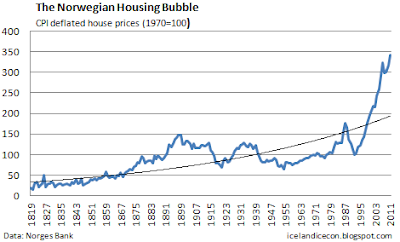
Behold the Norwegian Housing Bubble

Nuff' said!


And here is a comparison to Denmark and Sweden from  Statistics Norway.


In relation to this, the Norwegian Minister of Finance pointed out that households in Norway had never been so indebted. Now the only question is when the self-delusion will be realised by the public, which is probably going to be quite late as it is the common man himself who is doing the self-delusion.

Friday, 6 April 2012

How To Create a Housing Market Bubble

You allow the banks to lend out as much as they want. Graphically, that would be something like this:

New loans to households in millions of krona (we use . instead of , to represent ,000s). In August 2004 the banks entered the mortgage market with at-that-time revolutionary type of mortgages: 25 or 40 years and 4.2% real interest rates (the principal was indexed to the CPI) which later were lowered to 4.15% due to fierce competition in getting people to borrow money. The result was a housing boom of extraordinary heights (see next graph) which is being corrected through inflation, although the recent spur of mortgage growth is halting that much needed correction. Many thanks to Thorvardur Olafsson and Karen Vignisdottir at the Central Bank of Iceland for the data.

What do the colours mean? Blue: mortgages in ISK, red: mortgages indexed to the value of foreign currencies (loans in ISK where the principal fluctuates with the value of ISK in foreign currencies), green: car loans in ISK, yellow: car loans in ISK but indexed to the value of foreign currencies. The indexation to foreign currencies was later (2011) ruled out to be illegal according to law from 2001 (a long story but rather representative of the scandalous workings of the Icelandic financial system).

Here is the house prices saga in Iceland:

House prices in Iceland according to Thjodskra

And people seriously say that we had a financial crisis because of the collapse of Lehman and other problems in international markets?! Please, this was a home-made problem, and we still haven't solved it!