In light of the acquittal in the Icesave case, I see a reason to post the press release from the Ministry for Foreign Affairs in its totality.
The interesting question which now remains is: are deposits in Europe safe? If e.g. Santander goes bankrupt, will the savers in the UK, which have deposited their savings at the Santander branches in the UK, be repaid? (Amongst other things, it depends on whether the Santander operations in the UK are under the umbrella of a branch or a subsidiary of Santander Spain. It also depends on whether the bank is a member of the UK deposit insurance scheme or not). Likewise, will a German customer of Bankia be repaid if the bank goes bankrupt? Who is meant to save Bankia in case of the need of a bailout: the German government? The Spanish one? Both?
Please, do note that I am not with those words questioning the security of UK deposits in Santender UK or German deposits in Bankia. I am merely trying to explain that the deposit insurance schemes in Europe are far from being fully funded and, in light of the acquittal, NOT automatically backed up by the States' finances.
Surely, the plans on creating a pan-European banking regulator will take this acquittal into the account when its formation will be decided.
Here is the press release (italics are mine):
Iceland welcomes acquittal in Icesave case
The EFTA Court ruling on Icesave rejected all claims by the EFTA
Surveillance Authority that Iceland should be declared in breach of the EEA
Agreement. The Court rejected the claim that Iceland has breached the Deposit
Guarantee Directive or has discriminated against depositors contrary to EEA
law. It is a considerable satisfaction that Iceland´s defence has won the day
in the Icesave case; the EFTA Court ruling brings to a close an important stage
in a long saga.
Iceland has from the start maintained that there is legal uncertainty as to
whether a state is responsible for ensuring payments of minimum guarantees to
depositors using its own funds and has stressed the importance of having this
issue clarified in court. There was, however, no realistic possibility of such
clarification until the EFTA Surveillance Authority decided to refer the case
to the EFTA Court.
This judgement concludes the procedures with the EFTA Surveillance Authority
in regard to the Icesave case. The ruling of the EFTA Court is final and cannot
be appealed. This case has been particularly difficult to handle both
nationally and internationally, and has occasioned, among other things,
considerable delays in the implementation of the Government´s economic
programme. Icesave is now no longer a stumbling block to Iceland economic
recovery.
It is important to bear in mind that payments from the estate of the failed
Landsbanki will continue regardless of the ruling of the EFTA Court. The assets
of the estate are now estimated to be 1,517 billion ISK which is approximately
200 billion ISK more than the priority claims which amount to 1,318 billion
ISK. Of these priority claims 1,166 billion ISK result from the Icesave deposits
while just under 150 billion ISK result from wholesale deposits, including
those from municipalities, charities etc. The sum of 660 billion ISK has
already been paid out of the estate against priority claims, i.e. around 50% of
their total value. Of this 585 billion ISK have gone to claims resulting from
the Icesave accounts. This sum amounts to over 90% of the total which the UK
and Dutch authorities advanced to cover the minimum deposit guarantee.
It is expected that the Icesave claims will be paid out in full by the
actual debtor, the estate of the failed Landsbanki. This outcome results from
the implementation of emergency legislation in 2008, according to which
deposits were given priority against unsecured claims.
Showing posts with label eurozone. Show all posts
Showing posts with label eurozone. Show all posts
Monday, 28 January 2013

Wednesday, 11 July 2012
Austerity and Interest Rates
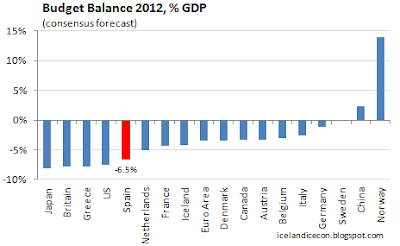
In light of Spain's toughening of austerity measures, it's worth doing a bit of data cracking and comparisons on budget deficits and government bond interest rates.
First, this is how the projected budget deficit of Spain compares to other economies. Data comes from the newest issue of The Economist (Iceland's budget deficit figure is full year 2011). According to the WSJ, the aim is to get Spain's deficit down to 6.3% this year (instead of previous target of 5.3%) and 4.5% in 2013. By 2014, the deficit is to dip back under the 3% Maastricht line: 2.8%.
The aim of the game is to get the interest rates down so Spain (and the EZ as a whole) doesn't collapse. That makes sense, looking at this scatter plot below: an obvious negative correlation between budget balances and interest rates, meaning that if a country is suffering increased budget imbalances, the interest rates on its government bonds tend to go up.

But oops, that's not what it seems to be when we look at countries with their own currencies and not the euro. They seem to be able to spend all they want without fearing higher nominal rate of interest. Yes, I know the 1970s and 1980s stories. But in times of dull economic activities, as is the case nowadays, it seems quite all right for the government to spend all it wants as long as the economy is using its own currency.

Both scatter plots above have outliers that could possibly be bending the fundamental relationship. So if we skip some notable outliers (Iceland, Norway [who has positive budget balance amounting to 13% of GDP anyway?], Greece, Spain, Italy) we get the following scatter plot.

Two things to notice about this final plot:
- it seems the relationship between budget balance and the rate of interest on government bonds is positive, completely contrary to neoclassical theory: if the state increases its budget balance, it will be charged higher rate of interest.
- all the EZ economies, except Germany, are above the trendline. Denmark is of course pegged to the euro, we can argue whether we should put it with the EZ economies or not.
So those fiscal-neoclassicals (commonly but incorrectly known as "Keynesians") out there might be right but maybe only half-right: we can end this depression now if we use the public finances to increase monetary demand in the economy and give people a chance to repay their debts, but only if the economies in question have their own currencies; the EZ economies would find this spend-and-survive strategy "a bit more" difficult.
Good luck Spain on cutting down the deficit, get unemployment down to humane levels and end this depression. You're going to need it!
First, this is how the projected budget deficit of Spain compares to other economies. Data comes from the newest issue of The Economist (Iceland's budget deficit figure is full year 2011). According to the WSJ, the aim is to get Spain's deficit down to 6.3% this year (instead of previous target of 5.3%) and 4.5% in 2013. By 2014, the deficit is to dip back under the 3% Maastricht line: 2.8%.
Projected budget deficits for 2012. Data from The Economist

The aim of the game is to get the interest rates down so Spain (and the EZ as a whole) doesn't collapse. That makes sense, looking at this scatter plot below: an obvious negative correlation between budget balances and interest rates, meaning that if a country is suffering increased budget imbalances, the interest rates on its government bonds tend to go up.
"Don't spend your money or we'll charge you extra high interest rates"

But oops, that's not what it seems to be when we look at countries with their own currencies and not the euro. They seem to be able to spend all they want without fearing higher nominal rate of interest. Yes, I know the 1970s and 1980s stories. But in times of dull economic activities, as is the case nowadays, it seems quite all right for the government to spend all it wants as long as the economy is using its own currency.
"You can spend your money all you want, as long as you can create it yourself"

Both scatter plots above have outliers that could possibly be bending the fundamental relationship. So if we skip some notable outliers (Iceland, Norway [who has positive budget balance amounting to 13% of GDP anyway?], Greece, Spain, Italy) we get the following scatter plot.
"Please borrow and spend, we'll charge you lower rate of interest if you do so!"

Two things to notice about this final plot:
- it seems the relationship between budget balance and the rate of interest on government bonds is positive, completely contrary to neoclassical theory: if the state increases its budget balance, it will be charged higher rate of interest.
- all the EZ economies, except Germany, are above the trendline. Denmark is of course pegged to the euro, we can argue whether we should put it with the EZ economies or not.
So those fiscal-neoclassicals (commonly but incorrectly known as "Keynesians") out there might be right but maybe only half-right: we can end this depression now if we use the public finances to increase monetary demand in the economy and give people a chance to repay their debts, but only if the economies in question have their own currencies; the EZ economies would find this spend-and-survive strategy "a bit more" difficult.
Good luck Spain on cutting down the deficit, get unemployment down to humane levels and end this depression. You're going to need it!
Monday, 9 July 2012
Is Iceland OK now? Economic figures comparison
I have been silent for a while here, apologies for that, as I'm on a vacation in France and working on the last draft of my PhD thesis on the sideline. Some exciting updates - from a nerdy point of view - coming up though and once the thesis is out of the way I'll get into proper research for the book I'm (supposedly) writing on the Icelandic economy.
Anyway, the hottest buzz on and about Iceland nowadays is that it's out of the recession.Gylfi Zoega, one of the foremost professors of economics at the University of Iceland, and a member of the monetary policy committee at the central bank of Iceland, said the recession was over. Krugman, who seems very fond of Iceland (come on over again and spend your dollars, we need them!) said that the country had broken all the rules, contrary to Ireland, "and things are not too bad."
Not too bad indeed: 4.2% GDP growth between 1Q12 and 1Q11. Iceland is back on track! How about "une petite coupe de champagne?"
Anyways, I've got my (usual) doubts and I've expressed them repeatedly (such as here, here and here). So as I was paging through the newest issue of The Economist I decided to use the figures at the back there to throw up this comparison of economic figures from all over the world.

This table can be fuzzy to read on its own to judge between the economic health of the economies in question. So I used the figures there to construct the following simple comparison table.
The following table does nothing but to give "points" to countries according to their relevant position to the other ones. As an example, the GDP growth in Greece is worst, so Greece gets 1 point for GDP growth. China is on the top, so they get 18 points for GDP growth. Likewise, only Iceland has worse current account deficit than Greece so the Mediterraneans get 2 points for that comparison. The total points of all the countries are then summed up in the right most column.
Looking at this table, Iceland's 4.2% GDP growth isn't so impressive any more. Like I said almost a month ago "well, yes, there is growth" but unfortunately, there seems to be not much more. Iceland's "not too bad" economic performance is still pretty damn bad.
(edit: 21:50) Initial calculations were wrong on the budget deficit comparison. That has now been corrected.
Anyway, the hottest buzz on and about Iceland nowadays is that it's out of the recession.Gylfi Zoega, one of the foremost professors of economics at the University of Iceland, and a member of the monetary policy committee at the central bank of Iceland, said the recession was over. Krugman, who seems very fond of Iceland (come on over again and spend your dollars, we need them!) said that the country had broken all the rules, contrary to Ireland, "and things are not too bad."
Not too bad indeed: 4.2% GDP growth between 1Q12 and 1Q11. Iceland is back on track! How about "une petite coupe de champagne?"
Anyways, I've got my (usual) doubts and I've expressed them repeatedly (such as here, here and here). So as I was paging through the newest issue of The Economist I decided to use the figures at the back there to throw up this comparison of economic figures from all over the world.
Figures from the newest issue of The Economist. Iceland's figure are from Statistics Iceland or calculated by myself. The CA/GDP figures are estimates for 2012, same goes for the Budget Balance figures. In the case of Iceland, I use the total CA/GDP figures (-7.0%) but some want to exclude the old banks from those figures since they are in receivership. If skipped, the figure drops down to -0.1%. Click to enlarge.

This table can be fuzzy to read on its own to judge between the economic health of the economies in question. So I used the figures there to construct the following simple comparison table.
The following table does nothing but to give "points" to countries according to their relevant position to the other ones. As an example, the GDP growth in Greece is worst, so Greece gets 1 point for GDP growth. China is on the top, so they get 18 points for GDP growth. Likewise, only Iceland has worse current account deficit than Greece so the Mediterraneans get 2 points for that comparison. The total points of all the countries are then summed up in the right most column.
Looking at this table, Iceland's 4.2% GDP growth isn't so impressive any more. Like I said almost a month ago "well, yes, there is growth" but unfortunately, there seems to be not much more. Iceland's "not too bad" economic performance is still pretty damn bad.
The comparative rankings of economic figures, using the data in the previous table. Norway wins (98 points) followed by Germany (82) and Sweden (80). Greece loses (23 points), Spain gets 29 points and Italy 34. Iceland is next (35 points).


The "economic points" of each nation (same data as in the table). Well done Iceland, you're in league with the best!

P.S. When are we going to start talking about the budget imbalances of Netherlands? Is 5.1% budget deficit just a-OK because Spain is rocking it at 6.5%?
(edit: 21:50) Initial calculations were wrong on the budget deficit comparison. That has now been corrected.
Monday, 18 June 2012
Greece today - Greece tomorrow?
Now when New Democrazy (sic!?) has won the Greek elections, everybody's eyes are on the Mediterranean. But after a super short bull run this morning everybody seems to be back into the "OK, so what now?" gear. Understandably, since it seems like it is just a question of time now when and how Greece defaults on the current "stabilisation" program. But will it go back, hat in hand, to Troika and ask for readjustments on the bailout or will it just outright default and exit the euro.
Who knows?! But for those of you who might want some clarifications of what the brush strokes of possibilities are, the classic "impossible trinity" might help.
Greece is as it is on the south side of the triangle, in the euro and with free flow of capital (as can be seen on the capital flight from Greece). If you're in a euro zone economy, you're perhaps more likely than not to think that Greece will stay on the south side (I can't find the link now, but the majority of economists from the euro zone countries don't think it will collapse while the opposite applies to economists from non-eurozone countries). But if they do not stay in the eurozone, how will the get out?

Now, regarding where Greece will be "tomorrow": it's not entirely impossible that Greece will lock down the economy with capital controls. The purpose would be to get out of the euro in a "tranquil" way, not with massive unrest and collapsing internet banks. Yes, it's not permitted to apply capital controls in the EU according to the Four Freedoms but Iceland did it and is still at it. And we're a member of the Four Freedoms contract as well through the European Economic Area. The ESA has said it is OK for us to lock the capital in, at least for the time being because of the systemic collapse, but they did as well state that they effectively could come knocking and tell us to open up any time.
I think most people who think Greece will exit kind of assume that one day the drachma will be recreated, free flow of capital still applied and the new currency allowed to plummet immediately. But why not lock the money in, recreate the drachma and then devalue the currency through the central bank? Is it impossible they will do that in the end?
Anyway, whatever happens the choices the Greeks have are pretty limited. They can either stay in the euro and have a slowly decaying economy or they can rip the plaster off, experience the massive default-pain and then hopefully get back up again later. Judging from the results of the elections, they are still up for the euro deal. Still. But maybe not tomorrow.

Who knows?! But for those of you who might want some clarifications of what the brush strokes of possibilities are, the classic "impossible trinity" might help.
Greece is as it is on the south side of the triangle, in the euro and with free flow of capital (as can be seen on the capital flight from Greece). If you're in a euro zone economy, you're perhaps more likely than not to think that Greece will stay on the south side (I can't find the link now, but the majority of economists from the euro zone countries don't think it will collapse while the opposite applies to economists from non-eurozone countries). But if they do not stay in the eurozone, how will the get out?
The impossible trinity and Greece. Greece is currently placed on the south side with fixed exchange rates (the euro) and free flow of capital. Doing so, they sacrifice independent monetary policy. But they could go for either the north-east or north-west sides as well. If they choose to adopt the drachma (independent monetary policy) they have to decide whether they will allow the capital to flee (north-east side) or lock it in and then devalue (north-west). If they choose the north-west side, they effectively "go Argentinian" on the bond owners by unilaterally change euro-denominated bonds with drachma-denominated ones. Then, they allow the drachma to fall by 40-60%.

Now, regarding where Greece will be "tomorrow": it's not entirely impossible that Greece will lock down the economy with capital controls. The purpose would be to get out of the euro in a "tranquil" way, not with massive unrest and collapsing internet banks. Yes, it's not permitted to apply capital controls in the EU according to the Four Freedoms but Iceland did it and is still at it. And we're a member of the Four Freedoms contract as well through the European Economic Area. The ESA has said it is OK for us to lock the capital in, at least for the time being because of the systemic collapse, but they did as well state that they effectively could come knocking and tell us to open up any time.
I think most people who think Greece will exit kind of assume that one day the drachma will be recreated, free flow of capital still applied and the new currency allowed to plummet immediately. But why not lock the money in, recreate the drachma and then devalue the currency through the central bank? Is it impossible they will do that in the end?
Anyway, whatever happens the choices the Greeks have are pretty limited. They can either stay in the euro and have a slowly decaying economy or they can rip the plaster off, experience the massive default-pain and then hopefully get back up again later. Judging from the results of the elections, they are still up for the euro deal. Still. But maybe not tomorrow.
The two real choices Greeks have. They can either have the euro and a disastrous economy or adopt a new drachma and have a disastrous economy.

Monday, 14 May 2012
Another Look at the Eurozone Crisis
Used the OECD stats to make those:


One can see the investment boom in Spain and Ireland very clearly on those pictures. That boom was fuelled with credit (created at home and coming from Germany amongst other countries) even though it doesn't show on the graph above.
And with the same graph in mind, one can understand why employment has collapsed: lower investment - contraction in wage income - lower wage income - private debt distress - liquidation - fall in asset prices - lesser investment still... and so on.
The only way to keep employment and the economy going is to call for public investment projects (included in the investment graph) and if they don't come, next in line is government consumption, such as pension funds, employment benefits, etc., to maintain cash flows to the public since people don't get investment-employment any more.
But that wasn't allowed: Ireland's and Greece's state coffers were squeezed "since it is the solution to the eurozone crisis" said the slaves of some defunct economist. Ireland and Greece were in fact squeezed so hard that now they are squeezed more than the main squeezer is squeezing his coffers: Germany. Spain is just around the corner (see government consumption graph above).
So when the State cannot meet the collapse in demand from the implosion of investment, public and private, the unemployment skyrockets.


And when the unemployment goes up, as it did in the 1930s, we get to see social unrest and Molotovs flying:

And after the social unrest, the Molotovs and burned down buildings, we see nutcases and lunatics like those guys:

"Progress, far from consisting in change, depends on retentiveness. When change is absolute there remains no being to improve and no direction is set for possible improvement: and when experience is not retained, as among savages, infancy is perpetual. Those who cannot remember the past are condemned to repeat it."
Investment as a share of GDP, quarterly data, seasonally adjusted

Government consumption as a share of GDP, quarterly data, seasonally adjusted

One can see the investment boom in Spain and Ireland very clearly on those pictures. That boom was fuelled with credit (created at home and coming from Germany amongst other countries) even though it doesn't show on the graph above.
And with the same graph in mind, one can understand why employment has collapsed: lower investment - contraction in wage income - lower wage income - private debt distress - liquidation - fall in asset prices - lesser investment still... and so on.
The only way to keep employment and the economy going is to call for public investment projects (included in the investment graph) and if they don't come, next in line is government consumption, such as pension funds, employment benefits, etc., to maintain cash flows to the public since people don't get investment-employment any more.
But that wasn't allowed: Ireland's and Greece's state coffers were squeezed "since it is the solution to the eurozone crisis" said the slaves of some defunct economist. Ireland and Greece were in fact squeezed so hard that now they are squeezed more than the main squeezer is squeezing his coffers: Germany. Spain is just around the corner (see government consumption graph above).
So when the State cannot meet the collapse in demand from the implosion of investment, public and private, the unemployment skyrockets.
Unemployment levels in the eurozone - Total Unemployment

Unemployment levels in the eurozone - Unemployment amongst people under 25 years

And when the unemployment goes up, as it did in the 1930s, we get to see social unrest and Molotovs flying:
A motorcycle policeman burns as his colleague (right) tries to help him after protesters threw a gasoline bomb in Athens on Wednesday, Feb. 23, 2011. Scores of youths hurled rocks and Molotov cocktails at riot police after clashes broke out during a mass rally that was part of a general strike. Photo and text from The Washington Post

And after the social unrest, the Molotovs and burned down buildings, we see nutcases and lunatics like those guys:
Leader of Golden Dawn, an allegedly neo-Nazi Greek political party, and party supporters. Stinks like early 1930s
"Progress, far from consisting in change, depends on retentiveness. When change is absolute there remains no being to improve and no direction is set for possible improvement: and when experience is not retained, as among savages, infancy is perpetual. Those who cannot remember the past are condemned to repeat it."
Subscribe to:
Posts (Atom)