OK, I'm going to plead to my readers for assistance for my PhD. If people could answer the following questionnaire regarding interest rates and savings it would help me tremendously! It's only nine questions and it would only take about 5 minutes to answer them but your answers would assist my research a lot!
Thanks!!
http://www.surveymonkey.com/s/CVLNLPR
Wednesday, 23 May 2012

Tuesday, 22 May 2012
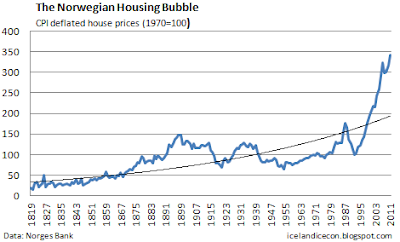
Behold the Norwegian Housing Bubble
Nuff' said!
And here is a comparison to Denmark and Sweden from Statistics Norway.

In relation to this, the Norwegian Minister of Finance pointed out that households in Norway had never been so indebted. Now the only question is when the self-delusion will be realised by the public, which is probably going to be quite late as it is the common man himself who is doing the self-delusion.
And here is a comparison to Denmark and Sweden from Statistics Norway.
In relation to this, the Norwegian Minister of Finance pointed out that households in Norway had never been so indebted. Now the only question is when the self-delusion will be realised by the public, which is probably going to be quite late as it is the common man himself who is doing the self-delusion.
Monday, 14 May 2012
Another Look at the Eurozone Crisis
Used the OECD stats to make those:


One can see the investment boom in Spain and Ireland very clearly on those pictures. That boom was fuelled with credit (created at home and coming from Germany amongst other countries) even though it doesn't show on the graph above.
And with the same graph in mind, one can understand why employment has collapsed: lower investment - contraction in wage income - lower wage income - private debt distress - liquidation - fall in asset prices - lesser investment still... and so on.
The only way to keep employment and the economy going is to call for public investment projects (included in the investment graph) and if they don't come, next in line is government consumption, such as pension funds, employment benefits, etc., to maintain cash flows to the public since people don't get investment-employment any more.
But that wasn't allowed: Ireland's and Greece's state coffers were squeezed "since it is the solution to the eurozone crisis" said the slaves of some defunct economist. Ireland and Greece were in fact squeezed so hard that now they are squeezed more than the main squeezer is squeezing his coffers: Germany. Spain is just around the corner (see government consumption graph above).
So when the State cannot meet the collapse in demand from the implosion of investment, public and private, the unemployment skyrockets.


And when the unemployment goes up, as it did in the 1930s, we get to see social unrest and Molotovs flying:

And after the social unrest, the Molotovs and burned down buildings, we see nutcases and lunatics like those guys:

"Progress, far from consisting in change, depends on retentiveness. When change is absolute there remains no being to improve and no direction is set for possible improvement: and when experience is not retained, as among savages, infancy is perpetual. Those who cannot remember the past are condemned to repeat it."
Investment as a share of GDP, quarterly data, seasonally adjusted

Government consumption as a share of GDP, quarterly data, seasonally adjusted

One can see the investment boom in Spain and Ireland very clearly on those pictures. That boom was fuelled with credit (created at home and coming from Germany amongst other countries) even though it doesn't show on the graph above.
And with the same graph in mind, one can understand why employment has collapsed: lower investment - contraction in wage income - lower wage income - private debt distress - liquidation - fall in asset prices - lesser investment still... and so on.
The only way to keep employment and the economy going is to call for public investment projects (included in the investment graph) and if they don't come, next in line is government consumption, such as pension funds, employment benefits, etc., to maintain cash flows to the public since people don't get investment-employment any more.
But that wasn't allowed: Ireland's and Greece's state coffers were squeezed "since it is the solution to the eurozone crisis" said the slaves of some defunct economist. Ireland and Greece were in fact squeezed so hard that now they are squeezed more than the main squeezer is squeezing his coffers: Germany. Spain is just around the corner (see government consumption graph above).
So when the State cannot meet the collapse in demand from the implosion of investment, public and private, the unemployment skyrockets.
Unemployment levels in the eurozone - Total Unemployment

Unemployment levels in the eurozone - Unemployment amongst people under 25 years

And when the unemployment goes up, as it did in the 1930s, we get to see social unrest and Molotovs flying:
A motorcycle policeman burns as his colleague (right) tries to help him after protesters threw a gasoline bomb in Athens on Wednesday, Feb. 23, 2011. Scores of youths hurled rocks and Molotov cocktails at riot police after clashes broke out during a mass rally that was part of a general strike. Photo and text from The Washington Post
And after the social unrest, the Molotovs and burned down buildings, we see nutcases and lunatics like those guys:
Leader of Golden Dawn, an allegedly neo-Nazi Greek political party, and party supporters. Stinks like early 1930s
"Progress, far from consisting in change, depends on retentiveness. When change is absolute there remains no being to improve and no direction is set for possible improvement: and when experience is not retained, as among savages, infancy is perpetual. Those who cannot remember the past are condemned to repeat it."
Thursday, 10 May 2012
Is Keynes's Clearing Union the Solution for Europe?
The Wolfson Economics Prize, about how to fix/break up the euro, was in the news some weeks ago. After having skimmed through, certainly not read thoroughly, some of the works that were handed in (I did read the entry of the 10 year old Dutch kid, thumbs up for trying) and with this paper in mind - A post-Keynesian interpretation of the eurozone crisis - it has started started to dawn upon me that Keynes may well have the solution: his Clearing Union (CU).
The essential core of the CU was that (current account) surpluses were to be recycled, in a way, between countries. The surpluses would build up as "pool of funds" (don't think for a second that I believe in the nonsense of Loanable Funds Theory just because I use this term) at the Clearing Union. Those surpluses would then be available to countries in deficits in the form of overdraft facility, at very low rate of interest. In today's Europe, the equivalents of the surplus countries are of course Germany and other current account surplus countries. The Peripheries are the deficits countries.
If the CU would be adopted between the countries of the euro zone the surplus of the Core would be up for grabs for the Peripheries, at a very low rate of interest. The Peripheries could therefore finance employment schemes and public investment projects with money from the Core, hoping that the resulting increase in income would get the economy back on track and possibly even getting some capital-and-income convergence with the Core.
In the meanwhile, the Surplus countries would be induced to spend more at the given exchange rate of the euro since the rate of interest of the surplus, ending up being a overdraft facility at the CU, is very low. The increased spending of surpluses would, if spent outside the euro zone, send the exchange rate down, assisting the deficit countries to export their way out of recession. If the spending is euro-zone-internal the increased income of the peripheries, as the surplus is recycled into imports from there into the core, would kick them out of recession.
Note that this system basically fights against huge disbalances in the current account between countries. Today's problem arise from the fact that even though the current account of the euro zone as a whole may be in balance to the rest of the world, there are huge imbalances between countries within the euro zone. This CU system would wipe those imbalances out or at least mitigate their negative effects as the deficits can be financed at low rate of interest.
The beauty of this CU system is that there doesn't seem to be any need to breakup the euro. Obviously, the creditor countries (the Core) are being asked to spend their own money to clear up the internal imbalances. If they don't want to do that, the debtor countries (the Peripheries) get the savings at a very low rate and can do what they want with it. No need for fiscal union.
I don't expect this idea to reach the ears of ruling politicians however, they are already "slaves to some defunct economist" who thinks the way out of the current problems is to apply more and more austerity. One can only hope they realise that it's like trying to put out fire with a dash of petrol.
The essential core of the CU was that (current account) surpluses were to be recycled, in a way, between countries. The surpluses would build up as "pool of funds" (don't think for a second that I believe in the nonsense of Loanable Funds Theory just because I use this term) at the Clearing Union. Those surpluses would then be available to countries in deficits in the form of overdraft facility, at very low rate of interest. In today's Europe, the equivalents of the surplus countries are of course Germany and other current account surplus countries. The Peripheries are the deficits countries.
If the CU would be adopted between the countries of the euro zone the surplus of the Core would be up for grabs for the Peripheries, at a very low rate of interest. The Peripheries could therefore finance employment schemes and public investment projects with money from the Core, hoping that the resulting increase in income would get the economy back on track and possibly even getting some capital-and-income convergence with the Core.
In the meanwhile, the Surplus countries would be induced to spend more at the given exchange rate of the euro since the rate of interest of the surplus, ending up being a overdraft facility at the CU, is very low. The increased spending of surpluses would, if spent outside the euro zone, send the exchange rate down, assisting the deficit countries to export their way out of recession. If the spending is euro-zone-internal the increased income of the peripheries, as the surplus is recycled into imports from there into the core, would kick them out of recession.
Note that this system basically fights against huge disbalances in the current account between countries. Today's problem arise from the fact that even though the current account of the euro zone as a whole may be in balance to the rest of the world, there are huge imbalances between countries within the euro zone. This CU system would wipe those imbalances out or at least mitigate their negative effects as the deficits can be financed at low rate of interest.
The beauty of this CU system is that there doesn't seem to be any need to breakup the euro. Obviously, the creditor countries (the Core) are being asked to spend their own money to clear up the internal imbalances. If they don't want to do that, the debtor countries (the Peripheries) get the savings at a very low rate and can do what they want with it. No need for fiscal union.
I don't expect this idea to reach the ears of ruling politicians however, they are already "slaves to some defunct economist" who thinks the way out of the current problems is to apply more and more austerity. One can only hope they realise that it's like trying to put out fire with a dash of petrol.
Tuesday, 8 May 2012
Guest Post: Is Iceland OK now?
Copy-pasted note from Gunnar Tomasson, ex IMF Senior Staff Member, he published on Gang8 website, answering Michael Hudson's question whether "Iceland was OK".
------------------------
RE: [gang8] Krugman's mistaken belief that devaluation saves anything, even over-indebtedness
No, Iceland is not OK now.
I’m just back in the US after three weeks in Iceland where I had an opportunity to talk to old friends from all parts of the political spectrum.
There is a strong feeling that the long-established political order has outlived its usefulness - if that is a term which can be used to describe its record.
Is Iceland really OK?
I was on the State TV program Silfur Egils on Sunday April 22.
In a 15-20 minute interview, I addressed among other things the insurmountable – on present policies – problems faced by Iceland in the monetary/balance of payments field.
Briefly, Iceland’s current foreign exchange reserves are of the order of ISK 1000 billion (US$ 1 = ISK 125).
Did I say reserves?
Yes, but they are borrowed reserves – not reserves that Iceland has accumulated from past surpluses on its balance of payments.
Iceland’s GDP is currently of the order of ca. ISK 1800 billion (my guesstimate – may be off by ISK 50 billion or so in either direction).
In October 2008 Iceland responded to the collapse of its banking system – and much else – by introducing pretty harsh foreign exchange controls.
For example, foreign owners of pre-crash Glacier Bonds were estimated to be holding ISK 400 billion which were essentially “locked in”.
Just recently, it dawned on the authorities – and, apparently, the IMF – that they had forgotten to factor in another factor.
The Icelandic currency claims of the creditors of the old banks, whose assets are being liquidated for eventual distribution to creditors.
So, to the ISK 400 billion, add another ISK 700 billion – and Iceland’s borrowed foreign exchange reserves become even less impressive than before.
That’s one part of the monetary/foreign exchange problem.
The other part resides in the globs of ISK monetary and other liquid assets left over from the “good years” prior to October 2008.
If the foreign exchange controls were lifted tomorrow, Iceland’s borrowed foreign exchange reserves would vanish in the blink of an eye.
In other words, from a macro-economic point of view, the REAL worth of foreign and domestic ISK balances waiting to exit through the foreign exchange market is a fraction of their pseudo-worth at the current ISK exchange rate.
What to do?
In Silfur Egils I made a twofold suggestion – a summary version is as follows:
1. Let the Glacier bond etc. money exit at a STEEP premium over the current exchange rate of the ISK.
2. Call in outstanding ISK balances and exchange them for New ISK at differential rates – say, one to one for household balances and something much less favorable for larger balances.
The problem at hand is clear as daylight – the chances of anything being done about it along the above lines are zilch, given the current political power structure.
What to do?
Change the current political power structure!
A general election must be held no later than a year from now and there is turmoil in the Old Guard and hopeful urgency in its would-be replacement which cuts across conventional political party lines.
I had an opportunity to meet one-on-one with leaders of two of the latter parties for lengthy and fruitful discussions.
I am hopeful that they will be able to join forces, attract a large number of voters – and
Throw out the rascals come next year!
------------------------
RE: [gang8] Krugman's mistaken belief that devaluation saves anything, even over-indebtedness
No, Iceland is not OK now.
I’m just back in the US after three weeks in Iceland where I had an opportunity to talk to old friends from all parts of the political spectrum.
There is a strong feeling that the long-established political order has outlived its usefulness - if that is a term which can be used to describe its record.
Is Iceland really OK?
I was on the State TV program Silfur Egils on Sunday April 22.
In a 15-20 minute interview, I addressed among other things the insurmountable – on present policies – problems faced by Iceland in the monetary/balance of payments field.
Briefly, Iceland’s current foreign exchange reserves are of the order of ISK 1000 billion (US$ 1 = ISK 125).
Did I say reserves?
Yes, but they are borrowed reserves – not reserves that Iceland has accumulated from past surpluses on its balance of payments.
Iceland’s GDP is currently of the order of ca. ISK 1800 billion (my guesstimate – may be off by ISK 50 billion or so in either direction).
In October 2008 Iceland responded to the collapse of its banking system – and much else – by introducing pretty harsh foreign exchange controls.
For example, foreign owners of pre-crash Glacier Bonds were estimated to be holding ISK 400 billion which were essentially “locked in”.
Just recently, it dawned on the authorities – and, apparently, the IMF – that they had forgotten to factor in another factor.
The Icelandic currency claims of the creditors of the old banks, whose assets are being liquidated for eventual distribution to creditors.
So, to the ISK 400 billion, add another ISK 700 billion – and Iceland’s borrowed foreign exchange reserves become even less impressive than before.
That’s one part of the monetary/foreign exchange problem.
The other part resides in the globs of ISK monetary and other liquid assets left over from the “good years” prior to October 2008.
If the foreign exchange controls were lifted tomorrow, Iceland’s borrowed foreign exchange reserves would vanish in the blink of an eye.
In other words, from a macro-economic point of view, the REAL worth of foreign and domestic ISK balances waiting to exit through the foreign exchange market is a fraction of their pseudo-worth at the current ISK exchange rate.
What to do?
In Silfur Egils I made a twofold suggestion – a summary version is as follows:
1. Let the Glacier bond etc. money exit at a STEEP premium over the current exchange rate of the ISK.
2. Call in outstanding ISK balances and exchange them for New ISK at differential rates – say, one to one for household balances and something much less favorable for larger balances.
The problem at hand is clear as daylight – the chances of anything being done about it along the above lines are zilch, given the current political power structure.
What to do?
Change the current political power structure!
A general election must be held no later than a year from now and there is turmoil in the Old Guard and hopeful urgency in its would-be replacement which cuts across conventional political party lines.
I had an opportunity to meet one-on-one with leaders of two of the latter parties for lengthy and fruitful discussions.
I am hopeful that they will be able to join forces, attract a large number of voters – and
Throw out the rascals come next year!
Gunnar
Subscribe to:
Posts (Atom)